Showing posts with label American Academy of Pediatrics. Show all posts

Friday, April 29, 2016

ILLINOIS: American Academy of Pediatrics backs down, a bit, sort of.

Pediatrics
May 2016

The Circumcision Debate: Beyond Benefits and Risks

by Andrew L. Freedman and M.D. Faap

In 2007, following a flurry of reports describing a benefit of circumcision in the fight against HIV, the American Academy of Pediatrics reconvened the task force on circumcision to update its policy statement of 1999.[1] Rather than simply incorporating this new information, the committee chose to start from scratch and rereview the medical literature. The task force’s work culminated in a policy statement published in 2012, the centerpiece of which was the statement that “the health benefits of newborn male circumcision outweigh the risks.”[2] This formulation of the debate, “benefits versus risks” rather than “medical necessity,” [or "benefits and harms", or "functions of the foreskin" or "ethics"]  resulted in wide-ranging ramifications.

To many, especially in the lay press, this was interpreted as moving the needle from a neutral stance, as the 1999 guidelines were viewed, to being pro circumcision. It was vigorously criticized by anticircumcision activists, as well as many, primarily European, physicians and medical societies. Difficulties with this approach included the lack of a universally accepted metric to accurately measure or balance the risks and benefits.  [In fact, the AAP made no effort to balance them at all] In particular, there was insufficient information about the actual incidence and burden of nonacute [or acute] complications [or death].[3] In this issue, Sneppen and Thorup[4] use meticulous epidemiologic technique to assess the likelihood of needing a circumcision in a society in which the cultural norm is to preserve the prepuce. [And they find that likelihood to be less than one in 200] Work such as this, along with the subsequent avalanche of reports evaluating the risks and benefits [What "avalanche" apart from a flurry of advocacy articles by wild-eyed Brian Morris?], has helped to inform and animate the dialogue among physicians with a stake in the circumcision debate. But has this really helped to inform the public? Or are we just arguing among ourselves?

What is often lost in the reporting on the American Academy of Pediatrics guidelines was the second half of the benefits/risk sentence, “the procedure’s benefits justify access to this procedure for families who choose it, ” and later “health benefits are not great enough to recommend routine circumcision.” [This line was missing from most summaries.] What was the task force really saying?

To understand the recommendations, one has to acknowledge that when parents decide on circumcision, the health issues are only one small piece of the puzzle. In much of the world, newborn circumcision is not primarily a medical decision. [In most of the world it is not a decision at all.] Most circumcisions are done due to religious and cultural tradition. In the West, although parents may use the conflicting medical literature to buttress their own beliefs and desires, for the most part parents choose what they want for a wide variety of nonmedical reasons.

There can be no doubt that religion, culture, aesthetic preference, familial identity, and personal experience all factor into their decision. Few parents when really questioned are doing it solely to lower the risk of urinary tract infections or ulcerative sexually transmitted infections. Given the role of the phallus in our culture, it is not illegitimate to consider these realms of a person’s life in making this nontherapeutic, only partially medical decision. [The owner of a phallus, unlike a mere penis, is an adult man. He is the only one with any right to make this nontherapeutic, only partially medical decision.] The task force was sensitive to the fact that as physicians, although we claim authority in the medical realm, we have no standing to judge on these other elements.

The ethical standard used was “the best interest of the child,” and in this setting the well-informed parent was felt to be the best proxy to pass this judgment. [But there is no need for a judgement, and hence no need for a proxy.] Protecting this option was not an idle concern [Who said this option has to be protected, or that paediatricians have any role in protecting it?] at a time when there are serious efforts in both the United States and Europe to ban the procedure outright. [No, only to agre-restrict it until the owner is of an age to decide for himself whether  he wants less penis. ]

...

In circumcision, what we have is a messy immeasurable choice that we leave to parents to process and decide for themselves rather than dictate to them. [False dichotomy. The real choice is between leaving the baby alone and anyone being allowed to cut healthy parts off her or him or them.]  This may seem odd in a society in which circumcision is rarely sought, but makes perfect sense in the multicultural world in which many of us live. [The elephant in the room here is the ethics of performing unnecessary, nontherapeutic, only partially medical reductive genital surgery on a non-consenting person.]

To the medical community, your efforts to improve our ability to accurately educate parents are needed. [Physician, educate thyself. Learn about the complex structure and many functions of the foreskin before you claim any right to educate others about it.] But we have to accept that there likely will never be a knockout punch that will end the debate.

...

To the anticircumcision activists, I would suggest that rather than directing an angry focus on the negative and the courts, your efforts would be better spent to educate and promote the prepuce positively [which is why we call ourselves "intactivists"] , to win in the court of public opinion, and to change the culture, so as to make having a foreskin be the “popular thing to do.” {He still doesn't get it. Having a foreskin is not something you do, because it is "popular". A foreskin is something you have as of right because you were born with it, unless someone steals it from you.]

I know it sounds naïve, but my challenge to all of us is to imagine a day we can peacefully live in a world in which not all penises have to look the same. ['Why can't we just get along?' They don't have to look the same, but how they look should be up to their owners, nobody else. And it's not all about looks.]


REFERENCES

 1. American Academy of Pediatrics. Circumcision Policy Statement. Task Force on Circumcision. Pediatrics. 1999;103(3);686-693. Reaffirmation published on 116(3);796

 2. American Academy of Pediatrics Task Force on Circumcision. Circumcision policy statement. Pediatrics. 2012;130(3):585–586

 3. Blank S, Brady M, Buerk E, et al; American Academy of Pediatrics Task Force on Circumcision. Male circumcision. Pediatrics. 2012;130(3).
Available at: www. pediatrics. org/ cgi/content/ full/ 130/ 3/ e756

4. Sneppen I, Thorup J. Foreskin morbidity in uncircumcised males. Pediatrics. 2016;137(5):e20154340
-----
POTENTIAL CONFLICT OF INTEREST: The author has indicated he has no potential confl icts of interest to disclose. [Except being paid to cut babies' genitals, and cutting his own son on his parents' kitchen table, contrary to all surgical protocols.]
 

To cite: Freedman AL and FAAP M. The Circumcision Debate: Beyond Benefi ts and Risks. Pediatrics. 2016;137(5):e20160594

Tuesday, February 18, 2014

BRAZIL, MEXICO, USA: Circumcision does not protect against HPV

They tortured the data, but it wouldn't confess.


February 12, 2014

Circumcision does not protect against HPV

But it may slow the clearance of a cancer-causing HPV strain
by Morten Frisch
[A] New well-designed cohort study from Brazil, Mexico and the United States with more than 4000 participants pulls one of the American Academy of Pediatrics' (AAP) most promoted health claims apart. Overall, during follow-up there was no difference in rates of new HPV infections between circumcised and intact men in the study.

HPV is the group of sexually transmitted agents (human papillomaviruses) that cause both anogenital warts (aka condyloma) and neoplastic lesions and cancers of both male and female genitalia, the anus and the tonsils.

Two types of HPV, known as HPV6 and HPV16, are responsible for the majority of all HPV-associated lesions, including genital warts (HPV6) and cancers (HPV16). While the overall findings of this study were negative, meaning that it found no overall differences between circumcised and intact men, among the few type-specific differences that were actually found, was a significantly reduced ability among circumcised men to clear their newly acquired HPV6 and HPV16 infections. This is particularly worrisome, because it is well-established that persistent HPV16 infection is the initial step on the path from HPV acquisition to cancer.

With this study, one of Brian J. Morris' and the AAP's most cherished arguments in favor of circumcision falls apart. Notably in industrialized parts of the world where the burden of heterosexually acquired HIV/AIDS - the main health problem circumcision is postulated to reduce - is low.

The paper must be even more disturbing to the pro-circumcision lobby, because two of its authors, Xavier Castellsague and Francois Xavier Bosch, are prominent co-authors of several prior papers suggesting a protective effect of circumcision against HPV infection, including the 2002 landmark study in the acclaimed New England Journal of Medicine [Rebutted on this site.], whose findings are now seriously undermined by their new and methodologically stronger study.
It seems there may soon be one pro-circumcision myth less to fight.

Monday, January 27, 2014

FLORIDA: "Boys not cut at birth may be later, so taxpayer should foot bill"

the Wall Street Journal
January 20, 2014

Circumcision Coverage Comes Into Focus

Revised Study on Procedure's Benefits Spurs Some States to Reconsider Ending Routine Medicaid Funding for Newborns
by Arian Campo-Flores
Saleem Islam, a pediatric surgeon in Gainesville, Fla., was surprised a few years ago when he started receiving a steady stream of referrals for older boys from low-income families to be circumcised.

"When we ask the parents, 'Why did you not get it done when the child was a baby and when it would have been safer?' they say, 'We couldn't afford it,' " Dr. Islam said recently.
[In other words, these babies never needed it, the parental whim had just overflowed. It is not safer as a newborn.]

Like a dozen other states, Florida ended Medicaid coverage of routine circumcisions for newborns after the American Academy of Pediatrics issued a lukewarm statement on the practice in 1999. While the organization concluded that removing the penis's foreskin has potential benefits, it found the data were insufficient to recommend it as a routine procedure. [If the data are insufficient to recommend it, how can the price make it recommendable?]

So Florida lawmakers justified their decision in part as a way to save money on what the AAP had deemed an unnecessary procedure.

Now, a revised policy statement by the AAP that takes a more favorable stance toward circumcision, along with a series of academic studies examining the impact of reduced coverage of the procedure, has cast a new spotlight on the decision by Florida and other states not to cover it under Medicaid.

In 2012, the AAP concluded that the benefits of circumcision outweigh the risks and justify "access to this procedure for families who choose it." The organization stopped short of recommending routine circumcision, however.

Public funding of routine circumcisions for newborns has been hotly debated in recent years. Supporters of the practice say it helps prevent urinary tract infections in babies and sexually transmitted infections, including HIV, later in life. But groups opposed to circumcision say the procedure is medically unnecessary and an unnatural, antiquated practice. [Also harmful, risky and a human rights violation.] In the case of the older boys referred to Dr. Islam, complaints ranged from inflammation to difficulty with the foreskin.

Ending Medicaid coverage of routine circumcisions may have stuck the state with a bigger bill instead, according to a group of University of Florida Health researchers that includes Dr. Islam. Costs for circumcisions more than doubled in the five years after the 2003 policy change, the study asserts. That was largely because families were opting to have the procedure done when boys were older—a more costly operation that Medicaid still covers if it is deemed medically necessary.

The number of boys ages 1 to 5 who were circumcised each quarter during the study period reached almost 1,000 in the third quarter of 2008, compared with a little over 500 in the fourth quarter of 2003. In every quarter, those figures exceeded the number of circumcisions for newborns.
[But raw numbers explain nothing withut context: birthrate and neonatal circumcision rate. If the neonatal rate is 100% the number of older boys available for circumcision is 0, so the only way it can go us up, whether there is any medical need or not.]

That helps explain why Medicaid costs for circumcisions in Florida climbed to $33.6 million in 2008 from $14.9 million in 2004, according to the study. [But so does inflation.] While the procedure costs as little as $250 for newborns, it can run more than $6,000 for older boys because they require general anesthesia and sometimes an operating room. Older kids also face a higher risk of complications, doctors say. [This is not true.]

"Given the costs to the state, it would make sense for the state to reverse" its decision, Dr. Islam said.
The Florida Agency for Health Care Administration, which administers Medicaid, said in a statement that the study "contains interesting points for discussion, but does not appear to provide conclusive medical evidence to allow for coverage of elective circumcisions."

Using a different database, the agency provided data showing circumcision costs under the traditional "fee-for-service" system in Medicaid dropped to $1.2 million last year from $2.3 million in 2002. But those figures don't include other ways Medicaid money pays for the procedure, such as through managed-care plans, Dr. Islam said.
[And his study doesn't include other costs of circumcision, such as the cost of repairing botches.]

Of the 18 states that no longer cover routine circumcisions, 12 made the decision in the wake of the AAP's 1999 policy statement. When the AAP came out with its revised position in 2012, some states weighed changing their policies. Medicaid officials in Utah recommended restoring circumcision coverage in 2013, but the legislature hasn't acted. Another effort by Colorado lawmakers to reinstate such funding failed last year, though the issue is likely to come up again this year.

Studies show the prevalence of circumcision has declined as more states have stopped paying for it. A 2009 paper published in the American Journal of Public Health found that hospitals in states where Medicaid covered the procedure had circumcision rates 24 percentage points higher than those in states that didn't, leading to potential health disparities.

Overall, newborn circumcision rates in the U.S. have been falling, to 58.3% in 2010 from 64.9% in 1981, according to the Centers for Disease Control and Prevention.

In preparing its 2012 statement, the AAP's task force on circumcision considered the fallout from the 1999 declaration, said Douglas Diekema, one of the members. The previous task force "had not foreseen that their statement would lead to a decrease in insurance coverage," he said.
[Yes, and it's all about the money.]
 
Around the same time, a team of Johns Hopkins University researchers published a study estimating that a 20-year decline in U.S. circumcision rates had resulted in $2 billion in health care costs to treat sexually transmitted infections and other illnesses in uncircumcised men and their female partners.
Anti-circumcision groups questioned the legitimacy of the Johns Hopkins analysis. And they cited a published response to the AAP statement by a group of mostly European doctors who said it reflected "cultural bias" in favor of the procedure.
[Not just any "group of mostly European doctors" but the heads or spokespeople for most of the paediatric associations of Europe.]

Dr. Islam said his stance on circumcision is neutral. "But if a family wants it done and we're going to fund it," he said, "it makes sense to fund it at the right time."
[Those are two big ifs, and why should they be connected?]

Earlier story

Wednesday, January 1, 2014

PITTSBURGH: Penis cut off, reattached, rabbi sued

CBS
December 27, 2013

Rabbi Sued After Baby Injured During Circumcision

[Every baby is injured during circumcision....]
by Marty Griffin
PITTSBURGH (KDKA) – The incident detailed in the lawsuit happened at the Tree of Life Synagogue in Squirrel Hill within the last year.

The Jewish circumcision ceremony was performed by Pittsburgh Rabbi Mordechai Rosenberg – who is also a mohel.

Sometime during the bris, according to the lawsuit, Rosenberg severed the baby boy’s penis.

The baby was rushed to Children’s Hospital, where doctors performed emergency microsurgery.

“If your finger, your thumb was cut off and was put back on, that is pretty exciting,” said renowned UPMC plastic surgeon Dr. Joe Losee.

Dr. Losee was not involved in the boy’s treatment and he can’t talk specifics.

But our sources say it took eight hours. The baby needed six blood transfusions and was hospitalized for nearly two months. Sources describe the reattachment procedure as successful.

Dr. Losee says microsurgery advances every day, but it’s risky.

“Sometimes, it doesn’t always work,” he says. “When you’re reattaching a portion where you include nerves, sometimes the nerves don’t heal well beyond where you reattached it. So there are limitations for sure.” [The foreskin included nerves....]

On his website, Rabbi Rosenberg says he is recognized as a “certified mohel by the American Board of Ritual Circumcision.” His site also says “a doctor’s medical circumcision, usually performed in the hospital, is not considered valid according to Jewish law.”

“That is extraordinarily serious and is extraordinarily rare,” said attorney David Llewellyn.

Llewellyn handles cases involving injury during circumcision – injury brought on by both doctors in the hospital and mohels in religious ceremonies.

“Your average pediatric urologist probably spends about 20 percent of his or her time repairing children who have been circumcised,” Llewellyn says.

According to the American Academy of Pediatrics, one in every 500 newborn boys experience significant acute complications as a result of circumcision.

“This is pretty much unregulated,” Llewellyn said.

He says there is no regulated standard for training or certification of mohels, or any place for reporting injuries from circumcision.

“There’s virtually no regulation of this any place in the United States that I know of,” Llewellyn said. “I think the government probably should require some sort of training if this is going to be done.”

Rabbi Rosenberg told KDKA “I am trained in this.” He also called the case a “tragic accident” and a “horrible situation.” But also said he continues to perform circumcisions.

Sources close to the case say, while the baby is recovering, there’s no way to know if he’ll make a complete recovery. [Not until he's a man and using it.] The incident happened about eight months ago.

Thursday, December 12, 2013

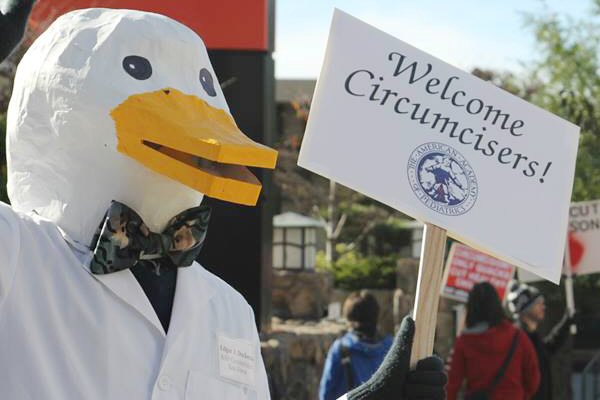
SAN FRANCISCO: "Dr Edgar Duckema" greets AAP delegates

Eider know, but this quacks me up...

December 8, 2013

Duck! Here comes quack Dr Duckema to confront baby cutters

''Dr Edgar Duckema'' welcomes AAP delegates
Click for video

Something eggstraordinary went, um, down at the Hotel Kabuki in San Francisco yesterday. A strange ducklike figure was greeting members of California Chapter 1 of the American Academy of Pediatrics as they arrived for a meeting at the hotel.

He was "Doctor Edgar J. Duckema", reportedly a circumcision enthusiast and American Academy of Pediatrics Circumcision Task Force member, quacking and holding a sign saying "Welcome Circumcisers!"

Others, members of the Bay Area Intactivists, carried signs saying "Circumcision Anguish" and "Circumcision? Only Quacks Cut Healthy Children".

Only one question: where should the doctor send his bill?

Saturday, November 16, 2013

FLORIDA: Fewer babies cut, hence more older boys

There are lies, damned lies, and statistics.


Health News Digest
November 13, 2013

Circumcisions in Older Boys and Related Costs Skyrocket in Florida

(HealthNewsDigest.com) - GAINESVILLE, Fla. - Circumcisions in Florida boys over the age of 1 have increased dramatically in recent years, doubling costs to the state, a study by University of Florida Health surgical researchers shows.

Saleem Islam, M.D., an associate professor in the College of Medicine department of surgery's division of pediatric surgery, said he and his study collaborators believe the state's decision to terminate Medicaid funding for routine circumcisions in babies under 1 month old has led to the increase in circumcisions for older boys. The study was published in the September issue of the journal The American Surgeon.
[Is anyone surprised? More intact babies means more boys available to be circumcised later. It would be surprising if a fall in newborn circumcisions did NOT lead to a rise in later circumcisions.]

Islam said families should decide for themselves whether to have their sons circumcised, but emphasized that circumcision in the newborn period is preferable for several important reasons.
[NOT circumcising at all is preferable to either early or late - especially to the penis's owner - for several important reasons.]
"The benefits are that the child does not have to undergo general anesthesia, there is much less cost to public monies, it's safer for the kids to get it done [Ther is no evidence for this] and that's the right age, as well," he said.
[Not circumcising has all those benefits and more. And what does "the right age" mean?]
 
Because newborns require only local anesthesia for a circumcision, newborn circumcisions are safer and much less expensive. They also have a lower risk of complications. Circumcising older boys requires general anesthesia to ensure the patient remains still during the procedure. [Yes, a baby can simply be strapped down.]

Florida was one of numerous states to stop Medicaid coverage for routine newborn circumcisions after a 1999 report from the American Academy of Pediatrics said the procedure may not be medically necessary.
[May not be? 2,000,000,000 happily intact males in the world prove it IS not medically necessary.]

Islam explained that circumcisions can increase hygiene in the penis, and some uncircumcised males suffer from recurrent urinary tract or penile infections. Some parents will choose circumcision because of these potential problems or for religious or cultural reasons. Islam said he does not take a firm stance either for or against circumcision, but prefers for parents to decide.

The state cut off Medicaid coverage for the procedure in 2001. Many insurance companies also stopped paying for newborn circumcisions after the report. Funding remains available for circumcisions in older males when the procedure is deemed medically necessary, such as when repeated infections occur.

In 2012, the American Academy of Pediatrics reversed its stance on routine newborn circumcisions, citing research indicating they may help protect against HIV and provide other benefits. [They did not reverse their stance, nor recommend it, they just shifted their collective bottom on the fence.]

UF Health researchers' study of data from 2003 to 2008 shows publicly funded circumcisions increased at a rate more than six times greater than the increase in privately funded circumcisions. They also cost approximately $111.8 million over the five-year time period, an amount estimated by medical facility charges during the study period. Fees for health care providers were excluded from the study, meaning the actual amount paid for the procedures was probably greater. The study results also showed that circumcisions in boys over age 1 were more common each year than those performed on newborns.
[What's missing here is, what proportions of babies and older boys were circumcised before and after funding was ended? When funding is ended and fewer boys are circumcised, the vast majority never need to be circumcised, saving public funding. (Even fewer are ever circumcised where circumcision has not been customary for more than a generation, doctors or their partners have foreskin asn the know its value, they are taught more about the foreskin than how to cut it off, and their anatomy texts actually show the foreskin.)]

By 2008, yearly Medicaid costs for circumcision in boys through age 17 reached $33.6 million, compared with $14.9 million in 2003. Meanwhile, private charges for circumcisions in Florida rose from $9.3 million to $14.1 million. Circumcisions in 2008 accounted for 30 percent of the estimated total costs for the procedure during the five-year window.

Islam said the increase in circumcisions among older boys likely stemmed from parents, supported by referring physicians, who had hygiene or medical concerns, but were unable or unwilling to pay for the procedure during the newborn period. UF Health pediatric surgeons noted they had talked with some of their own patients' parents about the decision to have an older boy circumcised and found that many parents would have opted for newborn circumcision if public funding were available.
[So what? Doubtless many parents whose son's DIDN'T have issues would have opted to cut them if the taxpayer paid for it.]

The American Academy of Pediatrics' new stance on the issue may lead states and insurance companies to restore funding for the procedure in newborns, a change Islam would welcome.

"It would make a lot of sense to offer it (newborn circumcision) to families who otherwise perhaps may not be able to afford it," he said, "and then say, ‘Here, we are offering it to you when your child is a newborn. You have a choice to make here. If you choose to get it done now, there are a lot of benefits over having it done later.'"
[And he says he's not pro-circumcision....]

Tuesday, August 27, 2013

NEW YORK: Western US circumcision rate falls dramatically

New York Times
August 22, 2013

Circumcision Rates in U.S. Drop Drastically in Western States


by Hope Reeves

¶ The percentage of male newborns who are circumcised in United States hospitals has dropped drastically. Over a 32-year period, the number of male newborns circumcised in the hospital decreased nationally to 58.3 percent in 2010 from 64.5 percent in 1979, according to new data from the Centers for Disease Control and Prevention.

¶ But while that 10 percent decrease over all is statistically significant, the authors of the report say, what leaps out of the data is a 37 percent drop in the West. In that 13-state part of the country, the rate of newborns receiving routine circumcisions at birth fell to 40.2 percent in 2010, by far the lowest rate in the country, from 63.9 percent in 1979. That decline accounts for virtually all of the shift nationwide.

¶ In the Northeast the overall trend was flat across the 32 years, with a high of 69.6 percent in 1994 and a low of 60.7 percent in 2007. Rates in the Midwest had dropped 3.3 percentage points over the period studied, with a high of 82.9 percent in 1998 and a low of 68.8 percent in 2009. The South’s rate increased 2.6 percentage points and ranged between 66.1 percent in 1995 and 53.8 percent in 1988.

¶ The authors cannot explain why the numbers dropped so precipitously in the West, which comprises Alaska, Arizona, California, Colorado, Hawaii, Idaho, Montana, Nevada, New Mexico, Oregon, Utah, Washington and Wyoming, because the analysis did not factor in contextual data. (These figures do not represent circumcisions performed outside of the hospital setting — e.g., ritual circumcisions — or any following discharge from the birth hospitalization.)

¶ “That question is beyond the scope of this report,” Maria Owings, the lead author, said.

¶ But it remains an intriguing question. Why would that part of the country differ so much from the rest? Have parents there developed a new attitude toward circumcision and, if so, why?

[What needs to be explained is not why the rate has fallen in the West, but why it has failed to fall in the rest of the country.]

¶ The high-profile 2010-11 attempt to get a bill criminalizing the procedure on a San Francisco ballot might have provided an opportunity for opponents of the procedure to reach parents. The initiative — called the Prohibition of Genital Cutting of Male Minors — was ultimately quashed, but it did get 12,000 supporting signatures.

¶ “San Francisco is a bastion for new thinking and individual rights, which draws many people to the region; however, the entire West Coast — Washington, Oregon — also have very low infant circumcision rates,” said Lloyd Schofield, the leader of the San Francisco movement. “Certainly much of this comes from basic awareness and less insistence on the procedure from the medical industry.”

¶ Mr. Schofield said that “a huge driver of the decline” was the nonpayment for the procedure by private insurers, “but in particular coverage was removed from Medicaid here decades ago.”

¶ “When the money is gone,” he said, “it no longer serves a purpose … funny thing about that!”

¶ Marc Stern, a lawyer for the American Jewish Committee who worked against the initiative, suggested that, among other things, the larger population of immigrants from countries that do not routinely circumcise could account for the low rates in the West. “Different cultures in Asia and the Americas and different attitudes towards circumcision may help explain the West’s differential,” he said.

¶ Douglas Diekema, a member of the American Academy of Pediatrics’ task force on circumcision and a professor of pediatrics at Seattle Children’s Hospital, echoed Mr. Stern’s theory that the difference in circumcision rates could be a result of demographics, but he had another theory, too.

¶ “The West Coast has more immigrants from populations that don’t circumcise as commonly as we do in the U.S.,” he said. “The Hispanic culture is one of those, and since the West and Southwest are taking on” more Hispanics, one could assume there would be a drop.

¶ At the same time, Dr. Diekema said, West Coast residents tend to be more progressive.

¶“Ever since the founding of this country, the West Coast has attracted people who walk to the beat of their own drummer,” he said. “People here are more likely to question the standard and go a different way.”

NEW YORK: US circumcision rate falls

New York Times
August 22, 2013

U.S. Circumcision Rates Are Declining


by Nicholas Bakalar

The percentage of newborns who are circumcised in the United States declined to 58.3 percent in 2010 from 64.5 percent in 1979, according to a new analysis from the National Center for Health Statistics. The report is based on annual surveys of about 450 hospitals nationwide.

But rates varied over the period. They went down during the 1980s after a task force of the American Academy of Pediatrics found that there were no medical benefits to the procedure, then rose during the ’90s after the medical group revised its position, claiming there were potential benefits. In 1999, the A.A.P. changed its view again, stating that despite potential benefits, there was insufficient evidence to recommend routine circumcision. That announcement was followed by another slight decrease.

There are regional variations as well. In 2010, about 71 percent of babies in the Midwest were circumcised, 66.3 percent in the Northeast, 58.4 percent in the South, and 40.2 percent in the West.

The lead author of the report, Maria Owings, a health statistician with the center, emphasized that the report includes no explanation for the numbers. “We didn’t factor in any other contextual information that would shed light on the reasons for the regional variations or the variations over time,” she said. And, she added, “The N.C.H.S. doesn’t take an advocacy position.”

Thursday, May 9, 2013

NEW ORLEANS: Intact America confronts Ob/Gyns at their conference

Intact America
May 4, 2013

Intact America Pickets Ob/Gyn Conference


Intact America's mobile banner at the ACOG conference, 2013
Intact America's mobile banner at the ACOG conference

Genital autonomy activists have gathered in New Orleans to call on the American Congress of Obstetricians and Gynecologists (ACOG) to join the global medical community’s movement away from neonatal male circumcision.

Intact America held a press conference, placed an advertisement in the New Orleans Times-Picayune and used a mobile billboard, saying “Tell America’s Obstetricians – No More Circumcision.” The sign includes the message “His Body, His Rights” to underscore the organization’s human rights concerns. Approximately 70 activists were expected to take part in the demonstration, displaying banners, carrying placards, and handing out literature

Executive director Georganne Chapin said, "The leaders of ACOG apparently do not think their members – who, according to estimates, perform at least half of the one million circumcisions in the United States on unconsenting baby boys each year – should hear the arguments that have led medical authorities across the developed world to reject the surgery as unnecessary, inherently risky, and a violation of baby boys’ right to an intact body."

The ACOG rejected IA's application to rent space for an educational booth in the convention’s exhibition hall, saying male circumcision “is only indirectly related to women’s health and of only casual interest to members of ACOG.” So Chapin decided Intact America should communicate with ACOG directly.

“It is both sad and disingenuous that ACOG claims circumcision is of no interest to the very doctors who perform the surgery hundreds of thousands of times each year,” Chapin said. “It is also not surprising they have embraced the widely-discredited 2012 circumcision policy statement of the American Academy of Pediatrics (AAP)." That policy "lauded the benefits of circumcising infants, while admitting that evidence for such benefits is lacking, acknowledging that the risks have never been adequately studied, and ignoring the ethical problems inherent in permanently removing normal genital tissue from individuals who cannot consent.”

The AAP’s policy was endorsed by ACOG. In contrast, IA endorses the view of 38 international pediatricians, urologists and medical ethicists, whose response to the AAP is published in the its own journal, Pediatrics

“There is growing consensus… that physicians should discourage parents from circumcising their healthy infant boys,” the physicians say, “because non-therapeutic circumcision of underage boys in Western societies has no compelling health benefits, causes postoperative pain, can have serious long-term consequences, constitutes a violation of the United Nations’ Declaration of the Rights of the Child, and conflicts with the Hippocratic oath: primum non nocere: First, do no harm.”

“Intact America’s intent for this demonstration in New Orleans,” said Chapin, “is to make sure ACOG hears and understands the ethical quagmire they have put themselves into.”

Thursday, April 18, 2013

DENVER, COLORADO: Move to restore Medicaid circumcision funding fails

A lot of limp puns...

Colorado House Debate (audio)
April 4, 2013

Colorado house does not restore Medicaid circumcision funding


In the Colorado legislature, an amendment to restore Medicaid funding of circumcision was struck down on a technicality. It was moved by Rep Paul Rosenthal (D) who said "the AAP supports this amendment ... because they said that the benefits outweigh the risks...."

Rep Cheri Gerou (R) concentrated on making bad puns while asking for a No vote on the amendment.

Rep Claire Levy (D) said that the amendment is out of order because it would make substantive law via a footnote. That is how the chair ruled.

Earlier story

Thursday, April 4, 2013

ILLINOIS: The AAP gets letters

Pediatrics
April 3, 2013

The AAP gets letters


The American Academy of Pediatrics' journal, Pediatrics, has published three eletters opposing its Circumcision Task Force's reply to the 38 senior European critics of its 2012 policy statement. But it has published them in two different places.

This one is at "published letters"

Smoke and Mirrors

Christopher L. Guest, Co-Founder
Children's Health and Human Rights Partnership

In response to concerns raised by Frisch et al, the task force seems reluctant to concede any meaningful sensory function to the human prepuce whatsoever. It is astonishing that members of the task force are able to appreciate that the prepuce is richly innervated and contains Meissner's corpuscles, but they are "unable to speculate about the effect that circumcision might have on sexual function or pleasure." Surely the task force recognizes the obstinate relationship that exists between structure and function. Structure predicts function. Function is constrained by structure.

Histologic studies indicate that the prepuce is richly innervated and contains specialized corpuscular neuroreceptors. During erection, the prepuce retracts and everts to expose the erogenous internal mucosa to external stimulation. Does this not seem like a structure whose function is, at least in some way, related to sexual pleasure? Is it reasonable to speculate that the prepuce is more likely related to sexual pleasure than say, the Achilles tendon?

If members of the task force are unwilling to consider the effect that circumcision might have on sexual pleasure, parents should ask themselves the following question: "Do I think removing richly innervated tissue from my child's genitals is more likely to INCREASE sexual pleasure or do I think removing richly innervated tissue from my child's genitals is more likely to DECREASE sexual pleasure?" It seems rather disingenuous for members of the task force not to speculate about the sensory function of the prepuce but at the same time sanction its amputation. The response to concerns raised by Frisch et al is deliberately evasive - smoke and mirrors!

Conflict of Interest:
None declared


This is published at "early"

A goldfish knows nothing about water

Hugh P. Young, Independent researcher

A goldfish knows nothing about water. The American Academy of Pediatrics Task Force on Circumcision is unaware of the peculiar circumcising culture in which it is immersed. For example, characters in American TV sitcoms may exhibit a casual vindictiveness toward the foreskin, or the man with one, that would cause widespread outrage if it involved race.1 American medical texts portray "normal" penises as circumcised, and may define the foreskin as "the part removed by circumcision".2

This unawareness permeates the Task Force's 2012 circumcision policy.3 Dr Frisch and 37 eminent European pediatricians, speaking for 22 pediatric associations, and for 17 countries from Iceland to Lithuania, have accurately pointed it out. The Task Force's reply amounts to "Tu quoque" ("You're another").

Those countries have "a clear bias against circumcision" the same way they have "a clear bias against parentally-elective infant toe amputation". They have no Task Forces on Leaving Boys' Genitals Alone.

The reply, like the policy itself, discounts the only study that actually attempted to measure the sensitivity of the foreskin itself, by ignoring its main, uncontested, finding: "male circumcision ablates the most sensitive part of the penis."4

The Task Force admits the role of the innervation of the foreskin in experiencing pain, but not pleasure. Frisch et al. do not need to "speculate" about it: they almost certainly have foreskins, or partners who have them. Human lips also "have nerve fibers". Whose first thought about those would be how to minimise the pain of lip-removal? Who needs proof that the nerves of the lips are intimately involved in the pleasure of kissing? To deny that a richly innervated structure, near the head of the penis, with a unique rolling action, is involved in sexual pleasure, is perverse. Impairing that pleasure was one of the purposes of circumcision, explicit for 1900 years until "medical" circumcision became customary and a generation had grown up that had never experienced sex unimpaired5

The Task Force now admits that the basic right to physical integrity is an important one, but it ignored that important basic right in its 2012 policy.

It contrasts the harm of being circumcised (without any measure of the worst of that harm, such as major complications and death) with a new, undocumented and unmeasured "harm of not being circumcised", but such harm could equally apply to failure to amputate any other less-than-vital body parts, such as the earlobes.

The Task Force offers no rebuttal to Frisch et al.'s substantive case, based on the AAP's own policy, that the diseases circumcision reduces (if the studies the Task Force cites are to be relied on) are so rare, or of such late onset, or so readily prevented or treated, that circumcising infants to prevent them is a bad option compared to letting the child grow up to decide the fate of his own genitals.

Its original claim that "the benefits outweigh the risks" was made with no actual weighing. It is now nowhere to be seen, and goes undefended.

References

1. Young, H. "That Thing": portrayal of the foreskin and circumcision in popular media, in "Human Rights Under Assault: The Atrocity of Circumcision" (Springer 2008), and online at the Intactivism Pages

2. Roberts, A. The Complete Human Body, DK Publishing (2010): Guyton, AC, Hall, JE. Textbook of Medical Physiology Saunders (2000): McCracken, TO ed. New Atlas of Human Anatomy MetroBooks (2001)

3. American Academy of Pediatrics Task Force on Circumcision. Male circumcision. Pediatrics. 2012;130(3).

4. Sorrells ML, Snyder JL, Reiss MD, et al. Fine-touch pressure thresholds in the adult penis. BJU Int. 2007;99(4):864-869

5. Philo of Alexandria, Of the special laws, Book I (ii), in Works of Philo, trans. F. H. Colson, Loeb Classical Library, 1937, Vol. VII, p. 105

Conflict of Interest:
I edit the Intactivism Pages ("Circumstitions")
[A video version of this letter is on YouTube.]


This letter is published at both of the above sites:

Function follows form

Dennis C. Harrison, Independent researcher

The response of the AAP Task Force on Circumcision to the commentary by Frisch et al is marred by a lack of attention to detail and a disregard for elementary principles of biology. The Task Force asserts that "all of the commentary authors hail from Europe," when the affiliation of one of the authors, Noni MacDonald, MD, is listed as "Department of Pediatrics, IWK Health Centre, Dalhousie University, Halifax, Nova Scotia, Canada." A bit later the Task Force refers to the stance of "The Canadian Medical Society," a non-existent organization.

The authors dismiss four histological studies of the prepuce on the grounds that these studies "were not designed to correlate anatomic findings with physiologic or functional roles." It is true that the function of the prepuce has not been fully elucidated, but the link between form and function is an axiom of biology. It is reasonable to suppose that specialized sensory tissue at the business end of the penis serves a specific reproductive function. In the words of Sir James Spence, "nature is a possessive mistress, and whatever mistakes she makes about the structure of the less essential organs such as the brain and stomach, in which she is not much interested, you can be sure that she knows best about the genital organs..."[1]

1. Spence On Circumcision. Pediatrics 1965;35(2):220.

Conflict of Interest:
None declared

Tuesday, March 26, 2013

BERKELEY/ILLINOIS: Dr and lawyer slam ethics of AAP circumcision policy / Task Force defence: "Respect!"

March 24, 2013

AAP Circumcision Task Force fails again


by Hugh Young

In the latest Journal of Medical Ethics, a paediatrician and a lawyer have demolished the ethics of the 2012 American Academy of Pediatrics circumcision policy. (pdf may require opening in a reader to show the comments.)

They say the policy suffers from several troubling deficiencies, including "...the exclusion of important topics and discussions, an incomplete and apparently partisan excursion through the medical literature, improper analysis of the available information, poorly documented and often inaccurate presentation of relevant findings, and conclusions that are not supported by the evidence given."


  • Topics excluded:
    • Anatomy and function of the foreskin
    • Harm caused by its removal
    • Biomedical ethics
    • Human and children’s rights
  • Incomplete and partisan survey of literature:
    • Case reports, case series, ecological studies, reviews and opinions excluded
    • Studies finding detriments from circumcision excluded
    • Cost/benefit analyses that fail to find benefit ignored
    • No North American STD or HIV studies (which consistently fail to find circumcision benefit)
    • Cherry-picking from within studies
  • Improper analysis:
    • Internally contradictory statements
    • Conclusions that do not follow from data
    • No risk/benefit analysis (either of circumcision or intactness)
    • Move toward recommending based entirely on three African HIV studies
  • Poorly documented and inaccurate presentation:
    • Ignores anti-circumcision findings within cited studies
    • Gets numbers wrong, e.g. in cancer risk
    • Discusses circumcision, but not Gardasil, to prevent HPV
    • Fails to apply cost/benefit to UTI, the only early-onset risk
    • Fails to consider cost of meatotomy
  • Conclusions not supported by evidence:
    • Third-party payment called for, yet still "elective"
    • Doctors advised to be cultural brokers for parents


Accordingly, the critics say, the AAP should immediately replace its policy with one reflecting such critical concerns as the functions of the lost tissue, medical ethics and the importance of respecting non-consenting children’s rights.


This is followed by a reply by the Task Force (pdf may require opening in a reader to show the comments) that addresses none of the issues it raises, but just questions the tone of opposition to circumcision in general, asking four times that criticism to be "respectful".

This is essentially the fallacy of Appeal to Authority.

The most disrespectful word in the Svoboda-Van-Howe paper is "myopic".

This repeated demand for "respect" ignores one of the major realities of that case - that an increasing number of men are very angry that this was done to them, and they resent the lack of respect shown for the most intimate part of their bodies, for their individuality, their privacy, their religious freedom, their sexuality, their equality with women and for the security of their persons.

Nobody should be surprised when these men show disrespect toward those who stand by the ones who did that to them.

The Task Force claims to be "unbiased", unlike its critics, but it has an inherent bias to which it is blind: it treats cutting a normal, healthy, functional, non-renewing part of a baby's (and hence a man's) genitals off as if it were equal and opposite to just leaving the baby's body alone - when in fact it is is medically and ethically a different kind of activity, with a different kind of consequences.

The Task Force ends its reply "It is our fervent hope that, through the combined efforts of well-intentioned, open-minded researchers, we will achieve greater understanding so as to better serve our young patients."

The Task Force's melifluous, unctious tone belies its subject-matter, cutting parts off babies' genitals - "patients" who have nothing the matter with them. People from cultures where this is not a norm will be baffled by the disconnect between the Task Force's words and its actions.

Thursday, March 21, 2013

ILLINOIS: AAP exhibits cultural bias in its denial of it

March 21, 2013

AAP Task Force reveals cultural bias while denying it


by Hugh Young

Last August, the American Academy of Pediatrics released its new circumcision policy in a flurry of publicity. The policy claimed that "the benefits outweigh the risks" (without actually comparing them). It fell short of recommending universal infant circumcision, though it was widely reported as having done so, and it recommended that insurance pay for this "non-recommended " procedure.

This week, Pediatrics published a rebuttal from 38 heads or spokespeople for the paediatric associations of Austria, Britain, Denmark, England, Estonia, Finland, Germany, Iceland, Latvia, Lithuania, Norway, Sweden and the Netherlands, and senior paediatricians in Canada, the Czech Republic, France and Poland, accusing the AAP of cultural bias, and finding fault with its methodology, its conclusions, and its ethics.

The AAP has published their letter with a reply from its "Task Force on Circumcision" that just underlines the same cultural bias for which it was criticised. It basically says "You're another!" without noticing that leaving a child's genitals alone, doing nothing to them, is medically and ethically a different kind of thing from cutting part off.

They reveal their bias even while denying it: they refer to the whole penis as "uncircumcised" and discount the sexual value of the foreskin found by some studies because "the relevance to individuals undergoing circumcision during infancy was questionable." but with no consideration of their relevance to individuals not undergoing circumcision during infancy.

They falsely claim that "approximately half of US males are circumcised, and half are not." In fact, a chart in their own policy indicates the rate is more like 80%. This is in order that they can say "Although that [50:50 ratio] may lead to a more tolerant view toward circumcision in the United States than in Europe, the cultural “bias” in the United States is much more likely to be a neutral one than that found in Europe, where there is a clear bias against circumcision."

In fact, in Europe, the default position is to do nothing, simply to leave the child's body alone. No need for any "cultural bias" or any Task Forces on Leaving Children's Genitals Alone.

They go on "... a culture that is comfortable with both the circumcised penis and the uncircumcised penis would seem predisposed to a more dispassionate analysis of the scientific literature than a culture with a bias that is either strongly opposed to circumcision or strongly in favor of it."
In what mad world is the United States "a culture that is comfortable with" the whole penis when the Task Force won't even call it that? When a TV show can include nine negative references to foreskins and the men with them without exciting comment? (Positive references are virtually unknown.) To rebut the claim of the 38 that the foreskin has a sexual function, the Task Force says:

Members of the task force appreciate that the foreskin has nerve fibers: the task force clearly recommends adequate pain control for infants undergoing circumcision. However, the task force did not move beyond what these studies actually reveal (the foreskin has nerve bundles and pain fibers, the foreskin contains Meissner corpuscles, the inner surface of the foreskin resembles a mucous membrane) to speculate about the effect that circumcision might have on sexual function or pleasure.
The 38 European critics do not need to "speculate": its male members or their male partners will have foreskins. Of course the inner foreskin resembles a mucus membrane, because it is one - like the lips. The lips also "have nerve fibres". Whose first thought about those would be about how to minimise the pain of lip-removal? Who either doubts, or can find a study to prove, that the nerves of the lips are intimately involved in the pleasure of kissing? Who needs one?

The Task Force, both in its policy and this response to its critics, criticises the only study that actually attempted to measure the sensitivity of the foreskin itself by ignoring its main finding - that "male circumcision [removes] the most sensitive part of the penis."

They now admit that the critics' "argument about the basic right to physical integrity is an important one, ..." yet they ignored this important argument in their 2012 policy, and now they contrast it with a new, unmeasured and undocumented claim that "...it is also true that some males will be harmed by not being circumcised." By that reasoning, the man who had to cut his own arm off after it was trapped under a boulder in the desert was "harmed by not having had it previously amputated" but nobody would ever think that meant infant amputation should be given even a moment's consideration - yet this is just "to prevent zipper injury" writ large.

The Task Force says nothing about the critics' case, based on the AAP's own policy, that the diseases circumcision reduces are so rare, or of such late onset, or so readily prevented or treated, that circumcising infants to prevent them is a bad option compared to letting the child grow up to decide the fate of his own genitals.

Its claim that "the benefits outweigh the risks" is now nowhere to be seen, and goes undefended.

Earlier story

Monday, March 18, 2013

EUROPE: Thirty-eight top pediatricians slam AAP circumcision policy

Pediatrics
March 18, 2013

The following article is due to appear in the next issue of Pediatrics, the journal of the American Academy of Pediatrics.

It is signed by the heads or spokespeople for the paediatric associations of Austria, Britain, Denmark, England, Estonia, Finland, Germany, Iceland, Latvia, Lithuania, Norway, Sweden, and the Netherlands, and by senior paediatricians in Canada, the Czech Republic, France and Poland.

It comprehensively dismantles the AAP's 2012 circumcision policy statement.

Cultural Bias in AAP's 2012 Technical Report and Policy Statement on Male Circumcision

Abstract
The American Academy of Pediatrics (AAP) recently released its new technical report and policy statement on male circumcision, concluding that current evidence indicates that the health benefits of newborn male circumcision outweigh the risks. The technical report is based on the scrutiny of a large number of complex scientific articles. Therefore, while striving for objectivity, the conclusions drawn by the eight task force members reflect what these individual doctors perceived as trustworthy evidence. Seen from the outside, cultural bias reflecting the normality of non-therapeutic male circumcision in the US seems obvious, and the report’s conclusions are different from those reached by doctors in other parts of the Western world, including Europe, Canada, and Australia. In this commentary, a quite different view is presented by non-US-based doctors and representatives of general medical associations and societies for pediatrics, pediatric surgery and pediatric urology in Northern Europe. To these authors, there is but one of the arguments put forward by the AAP that has some theoretical relevance in relation to infant male circumcision, namely the possible protection against urinary tract infections in infant boys, which can be easily treated with antibiotics without tissue loss. The other claimed health benefits, including protection against HIV/AIDS, genital herpes, genital warts and penile cancer, are questionable, weak and likely to have little public health relevance in a Western context, and do not represent compelling reasons for surgery before boys are old enough to decide for themselves.
Authors and Affiliations (38 people)
  • Morten Frisch, MD, PhD: Consultant, Statens Serum Institut, Copenhagen, and Adjunct Professor of Sexual Health Epidemiology, Faculty of Medicine, Aalborg University, Aalborg, Denmark
  • Yves Aigrain, MD, PhD: Professor of Pediatric Surgery, Hôpital Necker Enfants Malades, Université Paris Descartes, Paris, France
  • Vidmantas Barauskas, MD, PhD: Professor and President of the Lithuanian Society of Paediatric Surgeons, Lithuania
  • Ragnar Bjarnason, MD, PhD: Professor of Pediatrics, Landspitali University Hospital, Reykjavik, Iceland
  • Su-Anna Boddy, MD: Consultant in Pediatric Surgery and Chairman of the Children’s Surgical Forum of the Royal College of Surgeons of England, UK
  • Piotr Czauderna, MD, PhD: Professor of Pediatric Surgery, Medical University of Gdansk, Gdansk, Poland
  • Robert P. E. de Gier, MD: Consultant in Pediatric Urology and Chairman of Working Group for Pediatric Urology, Dutch Urological Association, The Netherlands
  • Tom P. V. M. de Jong, MD, PhD: Professor of Pediatric Urology, University Children's Hospitals UMC Utrecht and AMC Amsterdam, The Netherlands
  • Günter Fasching, MD: Professor and President of the Austrian Society of Pediatric and Adolescent Surgery, Austria
  • Willem Fetter, MD, PhD: Professor and President of the Paediatric Association of the Netherlands, The Netherlands
  • Manfred Gahr, MD: Professor and General Secretary of the German Academy of Paediatrics and Adolescent Medicine, Germany
  • Christian Graugaard, MD, PhD: Professor of Sexology, Aalborg University, Faculty of Medicine, Denmark
  • Gorm Greisen, MD, PhD: Professor of Pediatrics, Rigshospitalet, Copenhagen, Denmark
  • Anna Gunnarsdottir, MD, PhD: Consultant in Pediatric Surgery, Landspitali University Hospital, Reykjavik, Iceland, and Karolinska University Hospital, Stockholm, Sweden
  • Wolfram Hartmann, MD: President of the German Association of Pediatricians, Germany
  • Petr Havranek, MD, PhD: Professor of Pediatric Surgery, Thomayer Hospital, Charles University, Prague, Czech Republic
  • Rowena Hitchcock, MD: Professor and President of the British Association of Paediatric Urologists, UK
  • Simon Huddart, MD: Professor and Honorary Secretary of the British Association of Paediatric Surgeons, UK
  • Staffan Janson, MD, PhD: Professor and Chairman of Committee on Ethics and Children’s Rights, Swedish Paediatric Society, Sweden
  • Poul Jaszczak, MD, PhD: Vice President and Chairman of the Ethics Committee of the Danish Medical Association, Denmark
  • Christoph Kupferschmid, MD: Practicing Pediatrician and Member of Ethics Committee of the German Academy of Pediatrics, Germany
  • Tuija Lahdes-Vasama MD: Consultant in Pediatric Surgery and President of The Finnish Association of Pediatric Surgeons, Finland
  • Harry Lindahl, MD, PhD: Associate Professor of Pediatric Surgery, Helsinki University Children's Hospital, Helsinki, Finland
  • Noni MacDonald, MD: Professor of Pediatrics, IWK Health Centre, Dalhousie University, Halifax, Canada
  • Trond Markestad, MD: Professor of Pediatrics, Chairman of the Ethics Committee of the Norwegian Medical Association, Oslo, Norway
  • Matis Märtson, MD, PhD: Consultant in Pediatric Surgery and President of the Estonian Society of Paediatric Surgeons, Tallinn, Estonia
  • Solveig Marianne Nordhov, MD, PhD: Consultant in Pediatrics and President of The Norwegian Paediatric Association, Norway
  • Heikki Pälve, MD, PhD: Chief Executive Officer of the Finnish Medical Association, Finland
  • Aigars Petersons, MD, PhD: Professor and President of the Latvian Association of Pediatric Surgeons, Latvia
  • Feargal Quinn, MD: Consultant in Pediatric Surgery, Our Lady's Children's Hospital, Dublin, Ireland
  • Niels Qvist, MD, PhD: Professor of Pediatric Surgery, Odense University Hospital, Odense, Denmark
  • Thrainn Rosmundsson, MD: Chief of Pediatric Surgery, Landspitali University Hospital, Reykjavik, Iceland
  • Harri Saxen, MD, PhD: Associate Professor of Pediatrics, Helsinki University Children’s Hospital, Helsinki, Finland
  • Olle Söder, MD, PhD: Professor and President of the Swedish Pediatric Society, Stockholm, Sweden
  • Maximilian Stehr, MD, PhD: Professor of Pediatric Surgery, Dr. v. Haunersches Kinderspital, Ludwig-Maximilians Universität, Munich, Germany
  • Volker C.H. von Loewenich, MD: Professor and Chairman of the Commission for Ethical Questions, German Academy of Pediatrics, Frankfurt, Germany
  • Johan Wallander, MD, PhD: Professor and Chairman of the Swedish Society of Pediatric Surgery, Sweden
  • Rene Wijnen, MD, PhD: Professor and Chairman of the Dutch Society of Pediatric Surgery, The Netherlands


Earlier story

BERKELEY: AAP circumcision policy rebutted in Journal of Medical Ethics

the Journal of Medical Ethics
March, 2013

Lawyer and pediatrician dismantle the AAP policy


An article in the Journal of Medical Ethics comprehensively takes down the American Academy of Pediatrics' 2012 circumcision policy.

Written by Michigan State University Clinical Professor Robert Van Howe and Berkeley lawyer J Steven Svoboda, it focuses on the ethical issues rather than the medical issues that concern the European pediatricians whose rebuttal is released today.

“The AAP ignores so many important topics that it is hard to know where to begin," Svoboda says. "For example, the anatomy and function of the foreskin are not mentioned. The AAP’s circumcision recommendations contradict its own bioethics policy statement, which requires pediatric care to be based only on the needs of the patient. Non-therapeutic circumcision is incompatible with widely accepted ground rules for surgical intervention in minors.”

“When physicians decide whether to do a procedure, they must, and normally do, exclude from their medical decisions non-medical factors regarding the parents’ culture. Contrary to what the AAP suggests, doctors are not cultural brokers. Their duty is promoting and protecting the health of their patients, not following practices lacking a solid ethical and medical foundation.”

Van Howe and Svoboda accuse the AAP of cherry-picking articles that support circumcision, and of taking passages out of context from within articles that do not support it.

They conclude that male circumcision should be neither recommended to parents nor funded by government insurance systems.

A few months ago, the Royal Dutch Medical Association favorably cited an earlier version of Svoboda’s and Van Howe’s article, noting that even if benefits do exist, the procedure can safely be delayed until the boy himself can make the decision.
Out of step: fatal flaws in the latest AAP policy report on neonatal circumcision
by J Steven Svoboda, Attorneys for the Rights of the Child, Berkeley, California, USA
Robert S Van Howe, Department of Pediatrics and Human Development, Michigan State University College of Human Medicine, Marquette, Michigan
ABSTRACT
The American Academy of Pediatrics recently released a policy statement and technical report on circumcision, in both of which the organisation suggests that the health benefits conferred by the surgical removal of the foreskin in infancy definitively outweigh the risks and complications associated with the procedure. While these new documents do not positively recommend neonatal circumcision, they do paradoxically conclude that its purported benefits ‘justify access to this procedure for families who choose it,’ claiming that whenever and for whatever reason it is performed, it should be covered by government health insurance. The policy statement and technical report suffer from several troubling deficiencies, ultimately undermining their credibility. These deficiencies include the exclusion of important topics and discussions, an incomplete and apparently partisan excursion through the medical literature, improper analysis of the available information, poorly documented and often inaccurate presentation of relevant findings, and conclusions that are not supported by the evidence given.

Sunday, March 17, 2013

OAKLAND: More than $80 million paid out for botched circumcisions

Attorneys for the Rights of the Child
March 16, 2013

More than $80,000,000 paid out for botched circumcisions


by Hugh Young

More than 80 million dollars have been paid out in settlements for botched and wrongful circumcisions since 1985, according to Attorneys for the Rights of the Child.

It has been compiling a list of cases since 1997 and first published it today.

They range from $22.8 million to a boy in Atlanta, Georgia who was severely burnt, down to $30,000 to a Palm Beach, California, boy who lost more than his foreskin to a mohel.

Two of the cases, totalling $18.3 million, were won against Mogen Circumcision Instruments Ltd, makers of the Mogen clamp. The company has gone out of business, but the Mogen clamp is still being used.

The number of botched circumcision cases that were settled out of court is unknown. The number that were successfully blamed on something else, such as an undiagnosed pre-condition or poor aftercare, is also, of course, unknown.

In its 2012 circumcision policy, the American Academy of Pediatrics said, "The majority of severe or even catastrophic injuries are so infrequent as to be reported as case reports (and were therefore excluded from this literature review)" before concluding (without actually weighing them) that "the benefits outweigh the risks".

Wednesday, March 6, 2013

CANADA: Ethicist plays down circumcision policy change

Canadian Medical Association Bulletin
February 5, 2013

ETHICS CORNER: CIRCUMCISION


by Dr. Jeff Blackmer, Director of Ethics, CMA

What advice should a physician give to parents considering whether or not to have their baby circumcised?

For some parents, the decision is easy because of religious tenets or family tradition. For others, it involves a struggle to balance competing evidence. In Canada this evidence is evaluated and the medical standard is set by the Canadian Paediatric Society (CPS), which since 1996 has held that “circumcision of newborns should not be routinely performed.”

However, in August the American Academy of Pediatrics (AAP) updated its 1999 policy on circumcision and cited evidence showing that the procedure offers some potential benefits, including lower risk of urinary tract infection (UTI), penile cancer and sexually transmitted disease (STD) infection.

There are, of course, provisos. For instance, most UTIs occur in the first year of life and can be avoided with proper hygiene, and the lower STD rates appear applicable only to certain populations, such as gay men. As well, most of the studies that were consulted by the AAP did not involve North American men. So what should doctors do when parents seek their advice? I would point out that the AAP guidelines do not advocate circumcision as standard practice and state that the final decision should be left up to the parents, as is currently the case. The CPS is currently reviewing the evidence and expects to release an updated statement of its own. Until then, its current advice stands.

So, despite all the recent publicity related to the AAP, not much has changed. Some parents will always choose circumcision, some will always reject it, and some will decide based solely on the evidence. The role of physicians in this decision-making process is simply to remain up to date on the evidence and do all they can to help parents make an informed decision.

Earlier story

CANADA: Paediatricians foreshadow circumcision policy change

O Canada
March 3, 2013

Canada's pediatricians set to reveal new policy on circumcision


The Canadian Paediatric Society is preparing to revise its position on circumcision.

Canada’s pediatricians are about to update their advice on whether baby boys should be circumcised, revising their stand for the first time in 17 years.

Their review comes as new Canadian research suggests half of expectant parents would consider circumcision if they had a son — and that the single most important factor is the circumcision “status” of the father.

The Canadian Paediatric Society’s old policy, issued in 1996, opposed routine circumcision of newborns.

The new statement is expected to be more neutral.

“There isn’t going to be a ‘prescription’ for Canadian males in terms of circumcision,” society president Dr. Richard Stanwick, chief medical health officer for the Vancouver Island Health Authority, told Postmedia News.

The organization has been struggling to put forward a balanced position “that captures the risks, and the benefits, but is also respectful of personal preferences [whose?], religious issues and many other things that dictate this decision,” Stanwick said.

The issue is so loaded with emotion and controversy that the new statement has been three years in the making. “There are very strong opinions on both sides of this issue,” Stanwick said.

“We know that we’re wading into something that, no matter what we write, will not be strong enough for probably either side.”

Last year, the American Academy of Pediatrics announced that the health benefits of newborn male circumcision outweigh the risks, a move that provoked demonstrations by anti-circumcision activists who view the procedure as genital mutilation of newborns. [No, who view it as unethical.]

The old policy deemed circumcision medically unnecessary for the “well-being of the child.”

But after a special task force reviewed more than 1,000 studies published over the past 15 years, the American doctors’ group now says that circumcision provides protection against urinary tract infections, penile cancer and the transmission of some sexually transmitted infections, including HIV.

The organization isn’t recommending universal circumcision. Instead, it says the final decision should be left to parents.

Circumcision involves the surgical remove of some, or all, of the foreskin from the penis. It is one of the most common surgical procedures performed worldwide. In hospitals, the procedure is usually performed by obstetricians soon after birth.

“Clearly there has been a lot of literature around the potential role of the avoidance of infection,” Stanwick said.

“But this also has to be balanced off against the fact that this is still a surgical procedure, and it is not without risk.”

Those risks can include bleeding and hemorrhage, infection, inflammation and tightening at the end of the penis [and major complications, loss of the penis and death.]

Any shift in policy would have to ensure, “are there enough skilled professionals around to do this, so that we don’t have a complication rate that is unacceptable and so that we’re not seeing males being significantly harmed by not having the properly trained people to do it,” Stanwick said. [Not any shift, only a shift towards recommending it. Sounds like he's gearing up for a major increase, and needing to recruit!]

The new policy statement is expected to be released before the pediatric group’s annual meeting in June.

“It would be great if we had absolute answers, but on this one, I don’t think we will,” Stanwick said.

“At the end of the day . . . it will very much be influenced by dad’s status, as well as the cultural and religious issues.” [What other surgical procedures are influenced by the father's status, cultural or religious issues?]

A new study found that the circumcision rates are heavily influenced by whether or not the father is circumcised.

University of Saskatchewan researchers, in a study published in the journal Canadian Family Physician, surveyed 230 parents attending prenatal classes in Saskatoon.

Overall, half — 56 per cent — said they would consider pursuing circumcision if they had a son. In cases where the father of the expected baby was circumcised, 82 per cent were in favour of circumcision, versus 15 per cent when the father wasn’t circumcised.

According to the researchers, Canada’s current circumcision rate is 32 per cent. In the U.S., rates are increasing, to 61 per cent of men, they said. [No, it is slowly falling,and 61% is approximately the rate at which babies are being circumcised.]

Monday, February 4, 2013

HELSINKI: AAP Policy; "routine circumcision is insane" - Paediatrics Professor

Pediatrics
January 22, 2013

Routine circumcision is insane


by Harry G Lindahl, Associate Professor of Paediatric Surgery
Helsinki University Children's Hospital


Re: "Circumcision Policy Statement" 130:3 585-586doi:10.1542/peds.2012-1989

The evolution of mammals gained speed about 65 million years ago, when a meteorite fell on Yucatan and killed the dinosaurs. For all that we know, at that time, the mammals had a foreskin. If the mammal foreskin would be such a harmful piece of tissue as the pro circumcision lobbyists claim, it certainly would have fallen off during the 65 million years of evolution. However, mammals, including the human species, still have a foreskin. Rat is the most successful mammal on this planet. It has a foreskin. Evolution is merciless, and whatever mistakes it makes about the less important organs, such as the brain or stomach, it certainly knows best about the reproductive organs.

Therefore, the claim, that there are health benefits in excising a piece of healthy tissue from the penis of a healthy neonate, is as absurd as would be the claim that amputating the left little finger of a neonate has health benefits. However, if you would make such an absurd claim, either of the prepuce or of the left little finger, you would have to provide the highest level of proof according to the principles of evidence based medicine. This means several randomized controlled studies performed by independent researchers, all having the same result. There is no such evidence, neither of the prepuce nor of the left little finger.

The AAP is having a "Circumcision task force". This is as absurd as having a task force for "The Routine Amputating of the Left Little Finger of a Neonate". Is the AAP insane? To an European Paediatric Surgeon it seems so.

Earlier story