Showing posts with label Cologne ruling. Show all posts

Wednesday, August 19, 2015

ESSEN, GERMANY: Hospital deters parents from cutting

The Jewish Post
July 21, 2015

German hospital working to deter parents from circumcising

Despite legislation enshrining the right to circumcision [or rather, to circumcise], the ritual still faces opposition in Germany, according to a local media outlet, which reported that a hospital in Essen is trying to convince parents to forgo the procedure for their sons.

The DerWesten.de news website cited Dr. Peter Liedgens, the director of pediatric surgery at Elisabeth Hospital, saying that he has managed to persuade three quarters of parents at his hospital to rethink circumcision. As a result, only 11 circumcisions were performed in the first quarter of 2015, down from 70 during the corresponding period the previous year.

The website also claimed that now the hospital would cease to perform any childhood circumcisions. However, a hospital spokesman clarified to The Jerusalem Post that, while it still performs circumcisions and has no plans on stopping, it performs them only on children above the age of one and only under general anesthesia.

“Circumcisions are performed only by our pediatric surgeons and not by ritual circumcisers on hospital grounds. So the new policy doesn’t really change anything concerning this procedure,” explained spokesman Thomas Kalhöfer.

Asked if the hospital would actively try to deter religious families from circumcising their children, Kalhöfer said that, “We respect the religious grounds of families asking for circumcision, and we don’t actively want to persuade them to desist.

“Our surgeons are arguing from a medical standpoint according to the new medical guidelines of the German Society of Pediatric Surgeons, who recommend to perform circumcision only for medical reasons,” he said, adding that the hospital’s policy toward circumcision has been in place since the beginning of the year.

In 2012, a court in Cologne ruled circumcision a form of bodily harm subject to criminal penalties, causing an international furor and vehement protests from Jewish organizations and the State of Israel.

While the Bundestag moved swiftly to pass legislation enshrining the right of German citizens to undergo circumcisions [no, to genitally cut non-consenting minors - the right of adults to be cut was never restricted], several German medical associations came out strongly against the practice.

There is no reason from a medical point of view to remove an intact foreskin from underage boys or boys unable to give consent,” the German Pediatric Association asserted in a 2012 statement.

Jewish groups have expressed growing concern over circumcision in recent years, in the face of campaigns to ban the practice in several countries and a 2013 resolution by the Parliamentary Assembly of the Council of Europe, which described circumcision as a “violation of the physical integrity of children.”

According to the American Academy of Pediatrics, “The health benefits of newborn male circumcision outweigh the risks, but the benefits are not great enough to recommend universal newborn circumcision,” and “the final decision should still be left to parents to make in the context of their religious, ethical, and cultural beliefs.”

“The Simon Wiesenthal Center calls upon authorities to insist that the religious rights of Jews and Muslims be protected,” said Rabbi Abraham Cooper of the center.

While Rabbi Pinchas Goldschmidt of the Conference of European Rabbis mused that “the decision of the hospital is not based on questions of the legality of circumcision, which is guaranteed by German law, but on the fact that less and less Muslims are interested in this procedure, a fact showing the assimilation of Muslims into a post Judeo-Christian Europe.”

However, the hospital’s policy does show “a certain bias,” he said, adding that “for Jews the address for Brit Mila [circumcision] should be the synagogue and not the hospital.” 

Sunday, May 18, 2014

COLOGNE: 2nd anniversary of historic genital autonomy ruling marked.

May 7, 2014

World Day of Genital Autonomy commemorated in Cologne

by Hugh Young
The second anniversary of a historic court ruling against male genital cutting has been commemorated where it happened.

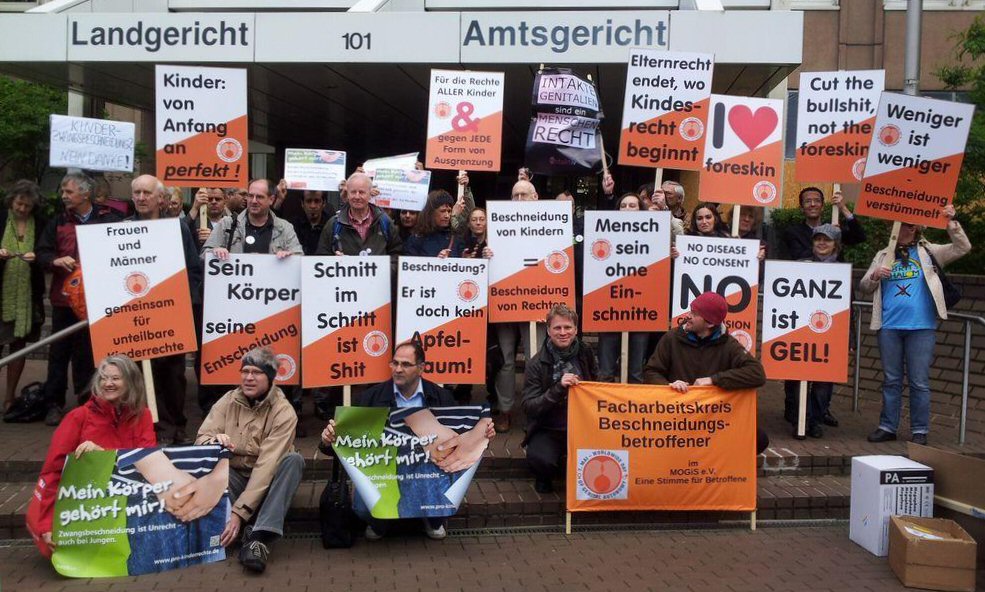
A crowd gathered outside the Cologne district courthouse to mark two years since the court ruled that infant circumcision was contrary to Germany's Grundgesetz (Basic Law).

Demonstration at Cologne courthouse, May 7, 2014

This followed the botched circumcision of a four-year-old boy of Muslim parents, putting him in hospital for ten days, and requiring corrective surgery under general anaesthetic.

The Grundgesetz was put in place in Western Germany in 1949, and later the whole country, at the same time as the Universal Declaration of Human Rights. Both were written in reaction to the horrors of the Nazi regime, such as the evil medical experiments on children by Dr Josef Mengele.

Under pressure from religious interests, the ruling was overthrown by a law whose constitutionality is still to be tested.

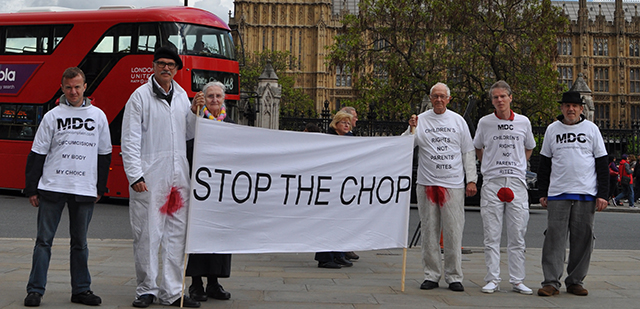
At the gathering, messages from genital autonomy organisations were read outside the courthouse, before the crowd of about 50 people marched to Cologne Cathedral for more speeches. Visitors came from France, Switzerland, Austria and Panama. The mood of everyone there was described as "good humoured". A similar event was taking place simultanously in London.

NORM-UK demo, May 7 2014 ''Stop The Chop''

Organisers plan to repeat the event annually.

Friday, December 13, 2013

GERMANY: Circumcision law has failed

Deutche Welle
December 12, 2013

German circumcision law still under fire

A year ago Germany, after a long and heated debate, passed a controversial new circumcision law. It was meant to be a Solomonic solution, but critics say that the new rules do not guarantee children's well-being.

A ruling by a Cologne regional court in the spring of 2012 set off a fierce debate over the Jewish and Muslim ritual of circumcision. The court decided that non-medical circumcision amounted to bodily harm. Both supporters and critics of the practice discussed the issue at length on television and op-ed pages, employing both medical and ethical arguments. The main question remained: how to reconcile freedom of religion and parents' rights to choose how to raise their children on the one hand, with the children's well-being on the other.

A law was passed that was meant to answer that question. Paragraph 1631d of the code of civil law declared that the circumcision of a male child is legal and must be done in accordance with "the rules of the medical profession" - as safely as possible and with appropriate and effective pain relief. Parents need to be informed of the procedure's potential risks, it must not pose a danger to the child's well-being, and the wishes of children old enough to express them also need to be taken into account. Representatives of Germany's Jewish and Muslim communities said they were satisfied with these conditions.

Justice Minister Sabine Leutheusser-Schnarrenberger, who introduced the bill, said the regulation re-established what was regarded as the status quo before the Cologne court's ruling.

But a year after coming into effect, the law is now a complete failure - at least according to critics, who say circumcision represents a violation of a child's physical integrity. Boys, critics said, often do not undergo the procedure under safe conditions and without appropriate pain relief.

"This law has legalized many questionable means of children's foreskin amputation," said Christian Bahls, head of the Mogis association, which advocates the physical integrity and sexual self-determination of children.

Bahls refers to a case in Berlin in which the Jewish method of Metzitzah B'Peh was carried out - where the circumciser sucks the wound with his mouth, and not with a pipette or a small tube. Because of the danger of infection, the Israel Ambulatory Pediatric Association (IAPA), among other associations, has already rejected the practice.

Mogis pressed charges against the boy's father, a rabbi, as well as his wife and the circumciser. But prosecutors dropped the case because no criminal responsibility could be proven against the parents, and the circumciser lived abroad and so was outside German jurisdiction.

Bahls says this outcome shows that the new law does not protect children's well-being properly. Prosecutors, he claims, dropped the case on the grounds that applying a painkilling bandage after the circumcision was enough to ensure medical safety. "So clearly it is permissible to amputate a child's foreskin without an adequate anesthetic," said Bahls. "That is what the law allows."

Wolfgang Gahr, general secretary of Germany's academy for children and young people's medicine (DAKJ), has also heard reports of circumcisions being carried out under hygienically questionable conditions and without anesthetic. "They are individual cases," he said. "We don't have any figures." The DAKJ is against non-medical circumcisions in general, but if they can't be avoided, "they should at least take place under medical supervision and be painless."

But this last condition is certainly not stipulated by the law, according to which children under six months are allowed to be circumcised by someone nominated by the religious community - in other words, a circumciser, who in most cases is not a doctor. That means he is not qualified to administer an anesthetic, says Gahr.

The Justice Ministry, on the other hand, cites what it claims is evidence that the law protects children's well-being - for instance a ruling made by a Higher Regional Court in September, which forbade a Kenyan woman from circumcising her six-year-old son because parents and doctors had not consulted the child, and because the parents had failed to properly inform themselves.

Germany's Constitutional Court has also had to address the law, after a man brought a lawsuit because he had been circumcised by someone without medical training, in 1991, when he was aged six. The judges dismissed his case because he was not currently directly affected by the new law. In other words, the court avoided addressing the new law itself.

Wednesday, May 22, 2013

COLOGNE: Two law professors slam German law

J Med Ethics doi:10.1136/medethics-2012-101284
May 22, 2013

Law Professors slam circumcision law


Two law professors, at the Universities of Hamburg and Passau, have published a joint paper in the Journal of Medical Ethics, slamming a law passed by the Bundestag last year. That law, pushed through under considerable pressure from religious interests, undermined an important determination of the Cologne District Court that infant circumcision is bodily harm.

After Cologne: male circumcision and the law. Parental right, religious liberty or criminal assault?
by Reinhard Merkel and Holm Putzke

Abstract
Non-therapeutic circumcision violates boys’ right to bodily integrity as well as to self-determination. There is neither any verifiable medical advantage connected with the intervention nor is it painless nor without significant risks. Possible negative consequences for the psychosexual development of circumcised boys (due to substantial loss of highly erogenous tissue) have not yet been sufficiently explored, but appear to ensue in a significant number of cases. According to standard legal criteria, these considerations would normally entail that the operation be deemed an ‘impermissible risk’—neither justifiable on grounds of parental rights nor of religious liberty: as with any other freedom right, these end where another person's body begins. Nevertheless, after a resounding decision by a Cologne district court that non-therapeutic circumcision constitutes bodily assault, the German legislature responded by enacting a new statute expressly designed to permit male circumcision even outside of medical settings. We first criticise the normative foundations upon which such a legal concession seems to rest, and then analyse two major flaws in the new German law which we consider emblematic of the difficulty that any legal attempt to protect medically irrelevant genital cutting is bound to face.

Earlier story

Saturday, May 11, 2013

COLOGNE, etc: Demonstrations mark court ruling

May 7, 2013

Demonstrations mark anniversary of Cologne court ruling


Demonstrations were held in widely-scattered places today to mark the first anniversary of the historic Cologne court ruling that infant circumcision is a breach of human rights.

That decision was subsequently undermined (but not overthrown) by a law pushed through under pressure from religious interests, allowing non-therapeutic circumcision.

In Cologne, German Pediatric Society President Dr. Wolfram Hartmann addressed a crowd outside the court where the decision had been handed down:


in English and German

In London, Men Do Complain demonstrated outside the German Embassy:


Demonstrations were also held in Chicago, Houston and New Orleans.

Sunday, March 31, 2013

LONDON: Two out of five would ban infant circumcision

Nearly two out of five support a ban on infant circumcision

Jewish Chronicle
March 27, 2013

Forty five per cent of Britons ready to ban shechita


by Simon Rocker

Almost half the population favour a ban on religious slaughter of animals for meat and nearly a third want a ban on male circumcision, according to the results of a YouGov poll for the JC.

Asked whether they support or oppose a ban on religious slaughter, 45 per cent back a ban, 27 per cent are against and 28 per cent say they do not know.

Opinion diverges less when respondents are asked about “male circumcision for religious reasons”, with 38 per cent [More like 2/5 than 1/3] supporting a ban, 35 per cent against and 27 per cent undecided.

Dayan Yisroel Lichtenstein, head of the Federation Beth Din, said: “It’s worrying and it shows we need to do a lot more public relations to put our case.”

...

Forty-one per cent of 18-24 year-olds would ban both shechita and circumcision.

...

The German government recently passed legislation to protect religious circumcision after a mohel was arrested last year. [No, not even detained, but convicted and discharged.]

...

But David Graham, senior research fellow of the Institute for Jewish Policy Research, cautioned against reading too much into the figures.

...

If people are asked are whether they support or oppose a ban on an issue, he said, “the seed of doubt is already sown in the respondent’s mind, before he or she has had a chance to consider what they are being asked. It is hardly surprising a majority opts for a ban.”

[Perhaps if the question had been,

"Do you think babies' genitals should
  1. be left alone?
  2. have part cut off?"
the proportion in favour of intactness would have been considerably higher.]


...

Saturday, March 16, 2013

LONDON: Doctors slam MP for pro-circumcision stance

Secular Medical Forum
March 11, 2013

Secular Medical Forum challenges Ed Miliband's support for religious circumcision


by

The Secular Medical Forum has condemned Ed Miliband's recent support for the ritual genital cutting of children and called on the labour leader to rethink his stance on the issue.

On 7 March Ed Miliband told an audience in London that he supports the practices of brit milah – a Jewish religious male circumcision ceremony performed on 8-day-old male infants. In reference to ritual circumcision and kosher animal slaughter, the leader of the Labour party said: "These are important traditions … ways of life must be preserved".

The removal of a young boy's foreskin is commonly practised in the UK for religious reasons. The Secular Medical Forum (SMF) argues that the operation disregards autonomy and exposes the child to significant risks, including bleeding, infection and death. In a statement, the SMF said it questioned Mr Miliband's support for the "ethically flawed and medically dangerous" procedure.

Anthony Lempert, Chair of the Secular Medical Forum, said; "The first principle of healthcare is 'primum non nocere – first do no harm'. This guidance is disregarded by supporters of ritual circumcision.

"The Secular Medical Forum calls on Mr Miliband to focus squarely on the rights of vulnerable infants and children. Mr Miliband should prioritise the rights of children rather than harmful religious traditions. Mr Miliband should defend the weak, rather than preserve abusive traditions. He should not be misled by misplaced allegations of anti-semitism against those striving to protect children from harm."

In 2012, a German court caused international controversy when it found that parental consent to religious circumcision was in conflict with the best interests of the child, and ruled that parents do not have the right to circumcise their children without a medical reason. Following the court ruling, the government of Angela Merkel introduced legislation permitting the tradition.

A full statement from the Secular Medical Form can be found here.

Monday, February 25, 2013

HESSE, GERMANY: Charges dropped against circumcising rabbi

Haaretz
February 24, 2013

German prosecutor drops anti-circumcision charges against mohel


by

Court says Hof chief rabbi, David Goldberg, who was charged in 2012 after a Cologne court ruled circumcision illegal in Germany, satisfies child welfare requirements.

A statement by the Hof prosecutor on February 21 said that Rabbi David Goldberg of Hof satisfied all requirements regarding child welfare “which are not jeopardized by the circumcision,” the Jewish-German publication Jüdische Allgemeine reported.

“Circumcisions which are applied with the consent of parents or custodians are not subject to criminal liability,” the prosecutor added. [The prosecuter seems to interpret the new law retrospectively.]

Charges were brought against Goldberg last year after a court in Cologne ruled that circumcision was illegal in Germany. Goldberg, who has been working as a mohel in Germany since 1997, said he was very pleased the case was now closed and that there was clarity on the issue.

“I never had any doubts, I still performed circumcisions,” he said. "But I think this is very good news for parents who did have doubts, and for the entire Jewish community.”

The German parliament has since passed a new law allowing circumcision, with some restrictions.

Earlier story

Sunday, January 13, 2013

SHEFFIELD, UK: Hospitals plan to charge for circumcision

National Secular Society
January 10, 2013

Sheffield hospitals plan to charge for non-medical circumcision

Hospitals in Sheffield carry out about 200 non-medical male circumcisions a year, costing the Health Authority in the region of £170,000. Now, in an attempt to save money, the NHS Sheffield's Clinical Commissioning Group has proposed to make families who want their sons circumcised pay for the procedure. Each operation costs about £1,000.

But Coun Shaffaq Mohammed, who is a director at the Pakistan Muslim Centre in Sheffield, is worried about the potential knock-on effects.

He told Postcode Gazette: "I'm very concerned. Whilst it may seem like an easy saving, this could lead to a serious increase in backstreet operations. This is a dangerous path to tread and as a result may actually lead to parents seeking emergency treatment and actually increase burden on the NHS."
[This argument is never used to justify state funding of female genital cutting.]

Dr Margaret Ainger, a GP from Page Hall medical practice on Owler Lane and lead for children's services in the NHS Sheffield Clinical Commissioning Group, said: "We understand that for some, circumcisions are an important part of their religion and therefore our doctors are working with our key community groups on how best we could make advice and guidance available to those who need it. Conversations with these groups are planned and we are keen to get people involved in tailoring this advice."

The cut is set to come into force in the 2013/14 financial year. The commissioning group has been in discussions with Sheffield Children's Hospital about the possibility of instead providing a private service at the hospital.

A report to be presented at a council meeting next week states: "(The team is) exploring the potential to develop a service which will provide care under local anaesthetic on a private basis and paid for by the children's parents."

Dr Ainger added: "No decision has been made as of yet but we are exploring what options would be available to the Sheffield public by working in partnership with both the Children's Hospital and local authority to make sure that any family wishing to circumcise their sons have the best possible advice and guidance available."

Male circumcision, which is the surgical removal of the foreskin, is often carried out for non-medical reasons such as religious beliefs or personal preferences. It is common in both the Muslim and Jewish communities.

According to national guidelines from the Department of Health, circumcisions should not be funded when they are requested for non-medical reasons. The proposals bring Sheffield into line with this national guidance.

Dr Ainger said: "Non-therapeutic circumcisions are not clinical interventions and as a group, we would not want anybody to undergo a medical procedure if there was no specific clinical need."

Terry Sanderson, President of the National Secular Society, commented: "This is yet another example of public money being used for religious purposes. There is absolutely no need for children to be subjected to such a procedure – in fact there are plenty of arguments why they shouldn't be. The idea that scarce NHS funding is being used for something that has only religious and no medical significance is scandalous.

"There is however a real danger that those seeking circumcisions will turn to practitioners without medical qualifications. We call on the Government to amend Child protection legislation to make it unlawful for anyone other than qualified medical staff to circumcise minors for any reason. This is just a first step, though. We believe that non-therapeutic circumcision should not be permitted until the boy is old enough to give informed consent.

"Non-therapeutic infant circumcision is a breach of children's rights and it's time legislators reconsidered the current carte blanche afforded to infant circumcision on the basis that the parents' freedom of religion is the only consideration. This approach has already been taken by a Cologne Court and is backed by reputable medical bodies including the Royal Dutch Medical Association."

Thursday, January 3, 2013

BERLIN: Green candidate stood down for anti-circumcision poems

Haaretz
December 31, 2012

German Green candidate quits over criticisms of Jews, Muslims

Ulf Dunkel had come under fire from the national Jewish spokesman over two anti-circumcision poems he published.
 
Germany's Green Party said Monday that a candidate who had described Jews and Muslims as "arseholes" because they practice male circumcision was withdrawing from a state poll.

Ulf Dunkel had come under fire from the national Jewish spokesman over two anti-circumcision poems he published.

One termed those who circumcise their sons "arseholes" and "blind fanatics." The other included the line: "Sharpen the knife, sing a hymn, cut off the member's foreskin."

Male circumcision, which is rarely practiced in Germany on medical grounds, triggered fierce controversy in the run-up to federal legislation, introduced in mid-December, which confirmed that it is legal for parents to arrange for religiously mandated circumcision. [The law does not mention religion.]

Michael Jaeger, of the Cloppenburg chapter of the Green Party, said that while Dunkel's name would remain on the ballot in a January 20 election for the Lower Saxony state parliament, the candidate would decline to take up his seat if elected. Dunkel could not be reached for comment.

Jaeger said it was too late to take his name off the ballot because postal voting in the state had already begun.

Dieter Graumann, chairman of the Central Council of Jews, earlier appealed to the Greens to withdraw Dunkel's candidacy. "His works radiate hate-filled arrogance towards Jews and Muslims," Graumann said.

Friday, December 14, 2012

BERLIN: Bundestag legalises circumcision, 100 oppose

Reuters
December 12, 2012

Germany passes law to protect circumcision after outcry


by Madeline Chambers


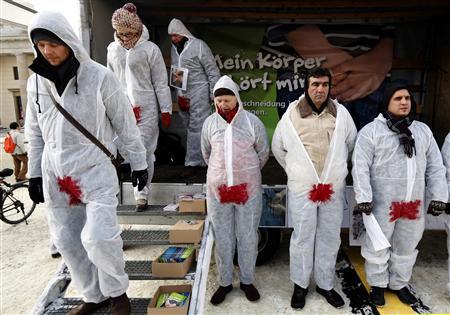
Protesters against circumcision, Berlin 12-12-12 Protestors in front of the Brandenburg Gate, Berlin
REUTERS-Pawel Kopczynski

(Reuters) - German politicians passed a law on Wednesday to protect the right to circumcise infant boys in a show of support for Muslims and Jews angered by a local court ban on the practice in May.

The ban - imposed on the grounds that circumcision amounted to "bodily harm" - triggered an emotional debate over the treatment of Jews and other religious minorities, a sensitive subject in a country still haunted by its Nazi past.

The outcry prompted Germany's centre-right government and opposition parties to draw up legislation confirming the practice was legal - overruling the decision by a court in the western city of Cologne.

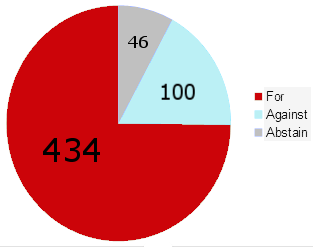
The new law passed by an overwhelming majority in Bundestag lower house said the operation could be carried out, as long as parents were informed about the risks.

[Hardly "overwhelming" - the 100 votes against were considerably more than expected.]

German vote piechart, 434 for, 100 against, 46 abstained

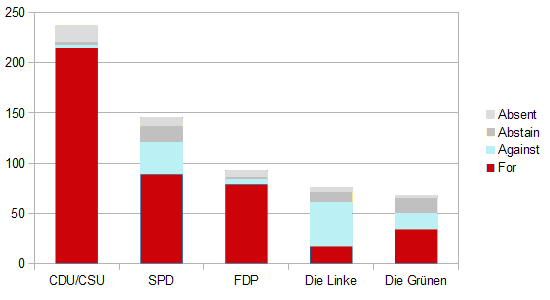
[By party: Angela Merkel's CDU/CSU most toed her line; only among the Communsts did most vote to protect children:]

Voting in the Bundestag, 12/12/12 by party

Jewish groups welcomed the move.

"This vote and the strong commitment shown ... to protect this most integral practice of the Jewish religion is a strong message to our community for the continuation and flourishing of Jewish life in Germany," said Moshe Kantor, President of the European Jewish Congress.

Germany's Catholic Bishops Conference said it hoped the bill would help safeguard religious freedoms. No comment was immediately available from the country's Central Council of Muslims.

PAIN MINIMISED

The May ruling centered on the case of a Muslim boy who bled after the procedure [requiring surgery under general anaesthetic and 10 days in hospital] and the ban only applied to the area around Cologne.

But some doctors in other parts of Germany started refusing to carry out circumcisions, saying it was unclear whether they would face prosecution.

Under the new law, a doctor or trained expert must conduct the operation and children must endure as little pain as possible, which means an anesthetic should be used. The procedure cannot take place if there is any doubt about the child's health.

Justice Minister Sabine Leutheusser-Schnarrenberger said no other country in the world country had made the religious circumcision of boys an offence.

"In our modern and secular state, it is not the job of the state to interfere in children's' upbringing," she said. [Cutting what other body part off is "upbringing"?]

Child welfare group Deutsche Kinderhilfe disagreed, saying the government had "(pushed) through the legalization of the ritual of genital circumcision ... against the advice of child right campaigners and the medical profession." [And against German's Grundgesetz - Basic Law]

Wednesday, December 5, 2012

BERLIN: Paediatric Association condemns circumcision law

Gesetzentwurf der Bundesregierung
November 27, 2012

German Pediatric Society roundly condemns infant circumcision.


Dr.Wolfram Hartmann, President of the Professional Association of Child and Youth Doctors in Germany, spoke on November 26, 2012 to the Bundestag committee considering the Government's "Draft law on the scope of child's care regulations at a circumcision of the male child" and the draft law of MPs Marlene Rupprecht, Katja Dörner, Diana Golze, Caren Marks, Rolf Schwanitz, other MPs: "Draft law on the scope of the child's care and the rights of the male child at a circumcision "

The Association opposes the first, which sets conditions for the performance of child circumcision, but no limit on who may do it, and supports the second, which sets a minimum age of 14, with informed consent.

Dr Hartmann told the committee

This statement is coordinated with the German Academy for Child and Youth Medicine (DAKJ), the umbrella organization of all pediatric associations in Germany (German Society for Child and youth medicine DGKJ, Professional Association of the Child and Youth doctors, German Society for social pediatrics and youth medicine DGSPJ), to which other organizations are co-opted (see also . I also refer to the statement of the Germany Society for Child Surgery) on that subject.

From a medical point of view, there is no reason to remove the intact foreskin of under-aged boys not capable of giving consent. In pre-school age, it is also very rare to have a true medical indication to remove (circumcise) the foreskin. At this age, the foreskin (prepuce) is physiologically more or less strongly fastened to the glans. Attempts to pull back the immature and adhered foreskin often cause inflammations and painful fissures.

"The male foreskin is part of the dermal organ and fulfills an important role in protecting the very delicate glans. ...

The repeatedly-quoted statement of the AAP contradicts earlier statements by the same organization, without being able to refer to new scientific evidence. The AAP statement has meanwhile been considered scientifically untenable by almost all pediatric societies and associations worldwide.

... The American lawyers association for children's rights, Attorneys for the Rights of the Child also criticized the AAP statement in a letter to the Pediatrics magazine [Which was not published there, but was published here]. It [says the AAP policy] contains errors and inconsistencies and violates both the AAP's own statements regarding bioethics, and several civil and criminal law regulations in the USA.

The WHO recommendations for prophylactic circumcisions only refers to mature, sexually active men in countries with low hygienic standards and is not suitable to justify the prophylactic circumcision of under-aged boys not capable to give consent. ...

.... The government's current draft law on the scope of child's care regulations at a circumcision of the male child unwillingly opens the door for demands to legalize the circumcision of girls.

Friday, November 23, 2012

BERLIN: Bundestag begins debating legal circumcision

DeutcheWelle
November 22, 2012

German parliament debates circumcision law


By Kay-Alexander Scholz
Germany's parliament has started debating a draft law on infant male circumcision. The government wants legal security for Muslim and Jewish traditions in Germany.

In May 2012, a Cologne court ruled that the circumcision of a young boy on religious grounds amounted to grievous bodily harm and therefore illegal.

...

The draft law foresees amending the German Civil Code by article 1631d, which is to be dedicated entirely to male infant circumcision. The operation would be legal if it is carried out according to "appropriate medical procedures" and does not endanger the child's health, for instance in the case of a hemophiliac. Persons other than doctors who are trained in the art of circumcision, such as Jewish mohels, will be allowed to practice the rite during the first six months of a child's life.

...

The Bundestag, or lower house of parliament, began its discussion on the legislation on Thursday (22.11.2012). An alternative draft law handed in by a group of opposition left-wing lawmakers was also on the agenda. They propose that parents should have to wait until their son is 14 so he can give informed consent for the procedure. After all, they argue, circumcision involves a grave operation in which the "foreskin is amputated."

This draft takes into account criticism by children's protection organizations and the Association of Pediatricians, which approved of the Cologne court's ruling. In this scenario, circumcision on the eighth day after birth, as is Jewish custom, would be impossible.

The Bundestag Legal Committee is scheduled to examine the medical risks circumcision entails at a hearing on November 26.

...
Earlier story

Tuesday, November 13, 2012

BERLIN: 50 Bundestag members against circumcision legalisation

NECN.com
November 12, 2012

German lawmakers want circumcision ban under 14


BERLIN (AP) — Left-wing lawmakers in Germany are threatening to oppose government efforts to keep male infant circumcision legal.

More than 50 lawmakers from three parties are proposing that parents should have to wait until their son is 14 so he can give informed consent for the procedure.

The proposal obtained by The Associated Press on Monday would radically amend a government bill that would give parents the power to decide.

The bill was prompted by a regional court ruling that circumcision could amount to criminal bodily harm. The government has enough votes to pass the bill and defeat amendments.

The June court ruling prompted outrage in Germany's Jewish and Muslim communities. Jews circumcise boys on the 8th day after birth and Muslims usually perform the procedure early in a boy's life.

Earlier story

Sunday, October 14, 2012

BERLIN: Cabinet approves bill allowing unnecessary "medical" circumcision

My body belongs to me! Forced circumcision is wrong - for boys too My body belongs to me!
Forced circumcision is
wrong - for boys too


Reuters
October 11, 2012

German cabinet approves bill allowing circumcision of boys


By Alexandra Hudson
BERLIN (Reuters) - Germany's cabinet approved a draft law on Wednesday protecting the right to circumcise infant boys, which it says will end months of legal uncertainty after a local court banned the practice, causing outrage among Muslims and Jews.

The June ruling by a Cologne district court that circumcision constitutes "bodily harm" sparked an emotional national debate about religious freedom and the procedure itself.

...

Parliament must still approve the bill for it to become law.

The speed with which national lawmakers agreed to draw up a new law underscored sensitivity to charges of intolerance in a country haunted by its Nazi past.

...

The bill states that the operation should take place with the most effective pain relief possible and only if parents have been fully informed about the nature of the procedure. It makes no mention of religious motivations for circumcision.

The court ban had applied only to the Cologne region but doctors across the country refused to carry out operations because of what they saw as a risk of legal action.

...

About 120,000 Jews are registered as living in Germany along with around 4 million Muslims, many of them from Turkey.

The Cologne court, ruling in the case of a Muslim boy who suffered bleeding [requiring surgery under general anaesthetic and 10 days in hospital] after circumcision, said the practice inflicted bodily harm and should not be carried out on young boys, although it could be performed on older males with their consent.


Anticipating the government bill, Berlin city authorities announced last month that parents were free to have their sons circumcised without fear of prosecution and the operations resumed in the German capital.


Deutche Welle
October 10, 2012

... The children's charity Deutsche Kinderhilfe was among the staunchest critics of the decision, calling it a "quick-fire" political solution that favored parents at the expense of their children's rights.

"While a smack is forbidden, now an irreversible procedure with the risk of considerable side-effects and pain should be allowed for almost any reason - such a decree in German law would enduringly weaken children's rights," the chairman of the charity, Georg Ehrmann, said in a press release, saying the move sent Germany back decades in terms of protecting the youn

Thursday, September 27, 2012

BERLIN: How Germany plans to break its own Basic Law

September 24, 2012

Germany abandons religious test for non-consented circumcision, opts for "medical"

The German Justice Ministry has released further details of its proposed law to enable unnecessary circumcision of non-consenting minor boys. They abandon the idea of an exemption for religious circumcision, but bring it under the rubric of "medical" circumcision. This is in spite of the fact that the change is being made specifically to allow religious circumcision. (There is virtually no demand in Germany for "cultural" circumcision like that in the USA.)
Circumcision of boys - Key Elements of a Regulation
I. Text of the Proposed Rules:

"Circumcision of the male child

(1) The child's care includes the right to consent to a medically not-indicated circumcision of a child who is not old enough to comprehend or consent, if these are carried out according to the rules of medical science. This does not apply if the child's welfare in endangered by circumcision, taking into account its purpose.

(2) In the first six months after birth, circumcision of a male child may be also carried out by individuals designated by religious groups, without being physicians, if they are specially trained."

II. Background

With the (legally binding) judgment of 7 May 2012 (document number: 151 Ns169/11, NJW 2012, 2128), the Regional Court of Cologne concluded that the circumcision of a 4-year-old boy was an illegal assault within the meaning of § 223 paragraph 1 of the Criminal Code (CC), even if undertaken in accordance with the rules of the medical profession and performed with the approval of the Muslim parents for religious reasons.

Parental consent was irrelevant because circumcision is contrary to the requirements of child custody to serve the child's best interests.

To address the resulting legal uncertainty, the German Bundestag requested the following of the federal government by order of 19 July 2012 (Bundestag printed paper 17/10331) [There was no "legal uncertainty" - non consented infant circumcision breaks the Basic Law - there is only a religious demand and political pressure.] :

"Taking into account the constitutionally protected parts of child welfare, physical integrity, freedom of religion and the right of parents to educate [but not to modify] as they see fit, submit [to us] a bill that ensures that a medically professional male circumcision without undue pain is generally admissible."
[Nowhere do they address the breach of gender-equality implicit in this. How will they resist, when Muslim parents demand the right to have doctors "circumcise" their daughters - minimally, surgicaly - under the same law?]

III. Key points of the proposed rule:

Custodial approach: The discussion centered on the question of the reach of parental authority. A regulation therefore should be enshrined and made clear with the Children's Law (§ 1631d BGB) that the parents (with custody under Article 6 Section GG 2, § § 1626, 1631 BGB) may consent to the circumcision of their son under certain conditions.

Parental consent shall preclude any claims of illegality of the procedure with the consequence that properly performed circumcision of boys cannot be punished as assault and no liability for damages shall trigger. [This seems to forclose the man's later right to sue for the wrong that has been done to him.]

Confinement of the proposed regulation to circumcision of boys unable to give consent: Only actually problematic circumcisions of boys unable to give consent would be governed by the judgment of the Court of Cologne.

Religious or ritual-traditional circumcisions are regularly performed at an age where children lack insight and judgment and therefore cannot render effective consent to the procedure. [An excellent reason not to do it to them without consent.] In Judaism, this means on the eighth day after birth. In Islam depending on the sect and culture it could mean anywhere from the seventh day after birth to about the end of primary school age.

Medically indicated circumcisions are excluded: Medically necessary (= Medically indicated) circumcisions are not the subject here, as there is common ground that parents have the authority to consent to medically indicated circumcision of children too young to comprehend and consent, as with any other medically necessary treatment of their child. [Thus any claims of medical benefit are irrelevant.]

No special religious requirement: The law shall be deliberately designed such that the requested circumcision is not dependent on a religious motivation to be legal. Otherwise legal practice would face before all else the difficult task of having to determine the content and specifics of religious beliefs. [Yet this is the sole reason for the "necessity" of a change to the law.]

Apart from religious bases, parents can appropriately elect the globally-now-common [No, only in the United State] , even though not medically indicated, circumcision of their son for an assortment of reasons having to do with beliefs about the welfare of their child. (See, for example, the opinion of the American Academy of Pediatrics from August 2012 that states the health benefits of newborns circumcision outweigh the risks. Pediatrics 2012, 130: 585-586 [Annotated here, video rebuttal here] ).

A scheme recognizing solely religiously-motivated circumcision of boys would not encompass all the varying valid reasons for choosing circumcision and would therefore not be fair or legally enforceable.

Conditions in the interests of the child: The consent of the parents must be bound up with child welfare-oriented conditions for the circumcision, which are increasingly being mentioned in the public debate on this issue (see Ethics, press release of 23 August 2012).

Parents should be able to provide consent for circumcision that is not medically indicated, on their son who cannot give consent, under the following conditions:

• Circumcision must be carried out according to the guidelines of medical science: This includes a professional execution of the procedure, hygienic conditions - as this is also covered by the rules of medical science - and the provision of effective pain management appropriate to individual cases and with respect to medical standards.

• Duty of circumcisers to fully educate parents before the procedure: A comprehensive explanation to parents of the consequences and risks is already a prerequisite for their effective consent under applicable law.
Properly warranted consent to a medically non-indicated intervention into someone's physical integrity is mandatory under current law. It requires an appropriate and more comprehensive explanation to the legal interest holder or - as here - his legal representatives. An additional mention of this requirement in the text of the proposed regulation is therefore not necessary.

• About the caveat of attention to the welfare of the child in paragraph 1, sentence 2, the constitutional protection mandate may be taken into account, if the circumstances of the individual case result in a hazard to the child. In this context any contrary will of the child may ["may"? Why not "must"?] also be take into account.

In Germany, the circumcision of children - even those carried out on religious or traditional grounds - is performed by physicians in a great many cases. However, religiously motivated circumcisions may also be performed by persons designated by a religious society.

The proposed plan allows such designated persons  to carry out circumcisions when they have been specifically trained and exhibit circumcision qualifications comparable to those of a surgeon. The conditions and requirements set out in Paragraph 1 above also shall apply to circumcisions by such persons.

The proposed regulation should limit the assessment of religious freedom on the one hand and the health interests of the child on the other hand to strictly the first six months after the child's birth. [Do children magically gain constitutional rights six months after they are born - or are they just easier to hold down? Is this all just about Germans being squeamish about forcibly circumicising boys old enough to complain?]

Wednesday, September 26, 2012

UNITED NATIONS: Humanists put circumcision on Human Rights Agenda

September 17, 2012

Humanists put circumcision ethics on UN agenda

The International Humanist and Ethical Union has presented papers to the United Nations Human Righs Council naming non-therapeutic circumcision as a human rights issue that requires the council's attention.

At the session of September 17, IHEU representative Josephine Mackintosh told the Council:
The recent German [Cologne district] court ruling outlawing non-therapeutic infant male circumcision correctly places the welfare, and the "fundamental rights and freedoms" of vulnerable children above the unrestrained expression of adult beliefs.

The court correctly determined that: non-therapeutic cutting of a child's body is an assault; that children are unable to give informed consent; that surrogate parental consent is not valid for an operation with no clinical indication and with the potential to cause serious harm; and that children have a right to be protected from bodily harm.

Such determinations cannot legitimately be overridden by adults convinced that children might be harmed by denying them this forced, irreversible surgery to their most intimate body parts. When the children become adult they can freely decide whether or not to undergo the procedure.

We understand, and have some sympathy with the sensitivities of certain religious groups which may feel threatened or even attacked by the judgment, particularly in the light of recent history. But it would be wrong to describe this judgment as religious persecution, or anti-Semitic; some Jewish voices are calling for an end to the practice and there is even an association called Jews Against Circumcision. Powerful groups must not be permitted to impose their views on the vulnerable on ideological or theological grounds in contravention of international law.

The Royal Dutch Medical Association and seven other Dutch scientific associations concluded in 2010 that the procedure can be harmful and that it violates the boy's human rights to autonomy and physical integrity.

The German judgment is therefore both laudable and overdue. Reflecting as it does States' obligations under the ICCPR, it should be followed by all member states.

Statement to the General Assembly

BERLIN: New law to require doctors for circumcision after 6 months

Reuters
September 25, 2012

Germany outlines new law allowing circumcision

By Christian Ruettger
(Reuters) - Germany's Justice Ministry has outlined a planned new law that will allow the circumcision of infant boys and end months of legal uncertainty after a local court banned the practice.

The ruling in June by a district court in Cologne outraged Muslims and Jews and sparked an emotional debate in the country, leaving an embarrassed government to promise legislation by the autumn protecting the right to circumcise.

Although the ban applied only to the Cologne region, doctors across the country refused to carry out operations because of what they saw as a risk of legal action.

The outline draft of a new bill states that the operation should take place "with the most effective pain relief possible" and only if parents have been fully informed about the nature of the procedure, a ministry spokesman said.

Generally doctors would carry out circumcisions but if the baby boy is less than six months old than it can also performed by another qualified person, such as a mohel, a Jewish individual specially trained in circumcising.

The ministry's outline bill, a first but critical step towards creating the new law, has been sent to Germany's federal states ahead of a consultation with experts due later this week.

...

Earlier story

Friday, September 7, 2012

BERLIN: Jews denounce conditions of circumcision acceptance

Vosizneias
September 6, 2012

Berlin - German Jews Reject Circumcision Terms

Berlin, Germany - Berlin’s Jewish community denounced on Thursday the city’s rejection of male circumcisions conducted by traditional specialists, saying the restriction was “flagrant interference” in religion.

The city-state of Berlin had announced a day earlier that it would not prosecute doctors conducting the ritual on boys in accordance with ancient Jewish and Muslim practice. But it said a mohel, a professional Jewish circumciser, could not claim the privilege.

The assembly of the city Jewish community passed a unanimous resolution saying, “this is flagrant interference in a Jewish tradition going back more than 3,000 years.”

A mohel is trained in the circumcision of baby boys and must live strictly according to kosher rules. Jewish groups said it would be rare to find a man who is both a mohel and a doctor at the same time.
The city-state said immunity from prosecution would apply on its territory if doctors used painkillers and obtained written parental consent and proof that the family belonged to a Jewish or Muslim community. Two other states said they had set similar conditions.

...

Jews are also concerned that Germany will demand use of a local anaesthetic during circumcision. One of Israel’s two chief rabbis has visited Berlin to say that this is not allowed in traditional circumcision.

Germany’s President Joachim Gauck released Thursday a letter to his Israeli counterpart, Shimon Peres, assuring him “the way of life and beliefs of Jews in Germany” needed to be protected. Peres had earlier asked Gauck to intervene and speak up for Jews.

Jewish groups plan a demonstration on Sunday in Berlin with Christian supporters to protest against the restrictions on circumcision. They have appealed to Muslims to also take part.

Muslims in Germany mostly ask doctors to perform circumcisions and have no equivalent of the mohel.

Earlier story

FRANKFURT: Doctor's circumcision video backfires .

Doctor's circumcision demonstration video, earpiercing comparision, both backfire
Frankfurter Allgemeiner
September 3, 2012
Ethikrat

Jacobs Beschneidung

Von Friederike Haupt
Ein Video zeigt, wie ein winziger Junge beschnitten wird. In einem anderen Film ist zu sehen, wie einem kleinen Mädchen Ohrlöcher geschossen werden. Beide Videos zeigte der Arzt Latasch auf einer Sitzung des Ethikrates. Die Reaktionen waren unerwartet.
Jacob war acht Tage alt, als ihm seine Eltern weiße Kleider anzogen und ihn in die Synagoge brachten. Andere Erwachsene filmten seine Beschneidung. Nun kann sie jeder auf Youtube sehen: „The Circumcision of Jacob Chai“. Das Video sollte dem deutschen Ethikrat vorführen, wie harmlos Beschneidungen von kleinen Jungen sind. Fünfzig Sekunden aus dem Leben von Jacob. Leo Latasch, ein erfahrener Anästhesist aus Frankfurt und Mitglied im Direktorium des Zentralrates der Juden in Deutschland, hatte das Video auf seinem Computer mitgebracht. Als Mitglied des Ethikrates hielt er auf der Sitzung Ende August den ersten Vortrag zum Thema Beschneidung; er kündigte an, dabei sowohl medizinische Fragen als auch religiöse aus jüdischer Sicht zu erläutern.
Nach drei Minuten kündigte der Professor an, dem Publikum zu erklären, wie eine jüdische Beschneidung funktioniere, „weil ich davon ausgehe, dass 99,5 Prozent derer, die hier überhaupt drin sind, noch nie eine Beschneidung gesehen haben“.... Dann startete Latasch den Ausschnitt von Jacobs Beschneidungsvideo, den er auf seinem Rechner gespeichert hatte.
... „Für die, die nicht geguckt haben: Der Eingriff hat circa zwölf Sekunden gedauert.“ Das Video endet mit Jacobs Schreien.
Aber die Mitglieder des Ethikrates und die etwa siebzig Zuschauer der öffentlichen Sitzung sahen und hörten noch mehr. Leo Latasch führte ein zweites Video vor, nur wenige Sekunden nach dem von Jacob. Der Film zeigte, wie einem kleinen Mädchen Ohrlöcher geschossen werden. ... Latasch hatte den Film ausgesucht, um zu zeigen, dass auch so etwas schmerzhaft und trotzdem erlaubt ist.
Doch währenddessen brach eine Frau im Saal ohnmächtig zusammen.... Ein Zuhörer rief „Sadist“ in Richtung Latasch. ... Latasch blickte zu Christiane Woopen, der Vorsitzenden des Ethikrates: Was war los? Woopen zuckte mit den Schultern....
Dann entschied er sich aber dafür, weiter zu machen, wie er später sagt. „Was Sie eben gesehen haben, ist das Setzen eines Ohrsteckers“, dozierte Latasch. „Wenn wir über Trauma reden, denke ich mir, dass man sich das mal mit angucken sollte.“ Ein Zuhörer rief noch „kannibalistisch“, dann ging die Sitzung weiter. Latasch sprach noch fast zwanzig Minuten, er redete von uneingeschränkter „Leistungsfähigkeit“ beschnittener Männer und der Unmöglichkeit, auf die Beschneidung Neugeborener zu verzichten.
...
Auch Jacobs Beschneidung ist nach wie vor im Internet zu sehen. Das Video, aus dem Latasch fünfzig Sekunden zeigte, dauert im Original allerdings acht Minuten und acht Sekunden. ...
Frankfurter Allgemeiner (edited Google translation)
September 3, 2012
Ethics Council

Jacob's circumcision

By Frederike Haupt
A video shows how a tiny boy is circumcised. In another film can be seen as a little girl pierced ears are shot. Both videos showed the doctor Latasch at a meeting of the Ethics Board. The reactions were unexpected.
Jacob was eight days old, when his parents put him in white clothes and took him to the synagogue. Other adults were filming his circumcision. Now they all can see on Youtube: "The Circumcision of Jacob Chai". The video was to show the German Ethics Council how harmless circumcisions of young boys are. Fifty seconds in the life of Jacob. Leo Latasch, an experienced anesthetist from Frankfurt and a member of the Board of the Central Council of Jews in Germany had brought the video on his computer. As a member of the Ethics Board at its late August meeting , he announced in the first discussion of circumcision that he would explain both medical and religious issues from a Jewish perspective.
After three minutes, the professor said he would explain to the audience how a Jewish circumcision works, "because I assume that 99.5 percent of those who are here have never seen a circumcision." ... Then started Latasch the edited video of Jacob's circumcision, which he had stored on his computer.
... "For those who have not watched. The surgery lasted about twelve seconds," The video ends with Jacobs screams.
But the members of the ethics committee and the audience of about seventy public meeting saw and heard more. Leo Latasch played a second video, a few seconds after Jacob's, of a little girl having her ears pierced. ... Latasch had chosen the film to show that also is something painful and still allowed.
But a woman in the hall fell in a faint.... Another visitor was so sick that he had to leave the meeting room. A listener called "Sadist!" at Latasch. ... Latasch looked to Christiane Woopen, the chairman of the Ethics Board: What happened? Woopen shrugged. ...
But then he decided to keep going, as he said later. "What you have just seen is placing a earring", lectured Latasch. "When we talk about trauma, I think that you should look at this too." A spectator shouted "Cannibalistic!" then the session went on. Latasch spoke almost twenty minutes; he talked of the undiminished "performance" of circumcised men and the [Jewish community's] inability to give up the circumcision of newborns.
...
Jacob's circumcision may still be seen on the Internet. The video Latasch showed lasts fifty seconds, but in the original eight minutes and eight seconds.
...
NSFW:

Foreskin torn from the glans at 3:09, sliced off at 3:24, metzitzah b'pen at 3:40.


[Maybe earpiercing is a better comparison with circumcision than we thought, and both should wait for informed consent.]