Showing posts with label male genital cutting. Show all posts

Monday, February 10, 2014

EASTERN CAPE: Doctor who showed botched circumcisions defended, attacked

The New Age (South Africa)
January 29, 2014

'Ban traditional circumcision'

by Sithandiwe Velaphi
A world renowned medico, Dr Robert WM Frater, has come out in support of a website [NSFW] set up by a former Eastern Cape-based state doctor that has exposed irregularities on circumcision in the province.

Frater, who operates in South Africa and England, said he first observed irregularities in the custom in the late 1940s when he visited the Eastern Cape at the time that he was still a medical student. [And he's done nothing about it for more than sixty years?]

Dr Dingeman Rijken, a Dutch doctor who worked at the department of health’s Holy Cross Hospital in Flagstaff in the Eastern Cape, set up a website to expose malpractices in traditional circumcision.
Rijken did this after 43 boys died last month due to botched circumcisions.

A total of 39 boys died in June last year, bringing the number of boys who died in 2013 to 82.

Frater said: “There are complications severe enough to cause death and when Dr Dingeman Rijken documented these on the web.”

The chairperson of the Eastern Cape House of Traditional Leaders, Chief Ngangomhlaba Matanzima, said Rijken had undermined the people of the province and their customs.

“It is clear that he would like Dr Rijken to cease his efforts to help.”

Frater is of the view that traditional circumcision should be aborted and replaced by medical circumcision. [Why replaced at all?]

“The time has come to start the process of removing traditional circumcision as part of the initiation rite,” he said.

The Film and Publication Board (FPB), which apparently called Rijken to come and explain reasons for setting up the website following a complaint from the Community Development Foundation of South Africa, said although the website was harmful to children under the age of 13, it was also educative.

“The website contains material which may be very disturbing and harmful to children [under the age of 13].

However it must be borne in mind that even though the website contains graphic images, it is a bona fide scientific publication with great educative value.

The website highlights the malice that bedevils this rich cultural practice,” the board said.
Matanzima said there was “nothing educative” about the website.

He blamed the FPB for not doing what it was supposed to do – which was to shut it down.
“Is exposing manhood an education? These are kids belonging to the community. Even if there was consent from them, this is damaging.”

“We as custodians of this custom have not authorised this doctor to do what he has done.”

“We as black people respect other people’s cultures even if there are wrongdoings.”

Earlier story

Saturday, May 18, 2013

SOUTH AFRICA: 23 die from circumcision

Herald Sun
May 17, 2013

Ritual circumcision kills 23 in S Africa


SOUTH African police said they had launched a series of murder inquiries after 23 males died while undergoing circumcision during traditional rites of passage into manhood.

The 23 - aged between 13 and 21 - died in various places across the country's northeastern Mpumalanga province over the course of a week.

"We have opened 22 cases of murder and one of inquest," regional police spokesman Leonard Hlathi told AFP.

One of the deaths was labelled an inquest because the boy reportedly had an existing health condition.

There have been no arrests yet as police compile statements and await post-mortem results.

Ritual circumcision is common among South Africa's ethnic Xhosa, Sotho and Ndebele ethnic groups.

Deaths at so-called initiation schools in South Africa are common, with several hundred cases recorded in recent years due to bleeding and infections.

Boys spend around a month in secluded bush or mountains areas for the sessions that also include lessons on the virtues of masculine courage and discipline.

There are usually two circumcision seasons - in winter during the months of May through July and in summer between November and December.

Government and the ruling African National Congress Party have expressed concern at the deaths which have nonetheless sparked little public outrage.

Government spokeswoman Phumla Williams called on the initiation schools "to ensure that precautionary health measures are exercised during this period to minimise illnesses and death".

Minister in The Presidency for Performance Monitoring and Evaluation, Collins Chabane said he was saddened by the loss of young lives.

The "loss of several young lives in Mpumalanga and elsewhere in the country is regrettable," Chabane said this week.

Earlier story

SOUTH AFRICA: More than 20 die from circumcision

Reuters
May 16, 2013

Over 20 South African boys die in circumcision rituals: police


by Jon Herskovitz, ed. Pascal Fletcher

JOHANNESBURG (Reuters) - More than 20 South African boys have died over the past week during coming of age rituals, police said on Thursday, and they blamed botched circumcisions as the likely cause of death.

Northern Mpumalanga province's police department has opened 22 murder cases but no arrests have been made so far, spokesman Colonel Leonard Hlathi said.

Every year in South Africa, boys aged 10 to 15 years from several of the country's tribal groups are circumcised in traditional "initiation rituals". The ceremonies usually take place over a number of weeks in remote rural areas.

Deaths are often caused by blood loss or infection when circumcisions are poorly performed by traditional practitioners. [The "poor performance" is a post-hoc judgement. Nobody checks how "well" the circumcisions were performed on the boys who didn't die.]

Minister in the Presidency Collins Chabane this week called the recent deaths "regrettable".

"This has happened to young people who were still at their prime, looking forward to a brighter future where they could still reach their potential," he said in a statement.

SOUTH AFRICA: More than 15 die from circumcision

The New Age (South Africa)
May 12, 2013

More than 15 die at initiation school


by Sphiwe Masilela

WITH just a week spent at the bush, at least over 15 boys have died at this year’s winter school and various police departments have launched investigations following the death of young boys who wanted to be men.

KwaZulu-Natal police spokesperson, Colonel Jay Naicker said Marian hill police were investigating a case of assault with intent to cause grievous bodily harm after more than eight boys between underwent circumcision.

“We can confirm an incident that occurred where more than eight boys between the ages of 13 and 15 were allegedly circumcised without their parent’s consent in Milkyway Road, Dassenhoek,”

Colonel Leonard Hlathi, Mpumalanga police spokesperson said they were also investigating cases of inquest following the death of eight boys aged between 15 and 21, who died at the initiation schools around KwaMhlanga and Verena areas respectively.

“The incidents occurred on the 08th and 09th of May 2013, where four of the victims were admitted at the local hospital and died later. Two were certified dead on arrival whilst two at one of the initiation schools,” said Hlathi.

He said a probe has been launched in regard to this incidents and the post-mortem will be conducted to determine the cause of death.

“Police are also in the process of verifying whether the initiation schools were registered or not,” he added.

An 18-year-old boy from Dennilton also died at the initiation last Tuesday in Bronkhorstspruit.

It is alleged that the boy bled a lot and resulted in the death.

Police spokesperson, Constable Zanele Vilakazi said: “An Inquest docket has been opened at the Bronkhorstspruit Police station and further investigations conducted to determine the cause of death. It is alleged that the young man was circumcised on Monday night and his body recovered in the early hours of Tuesday morning,” added Vilakazi.

No arrests have been made.

Sunday, April 7, 2013

OCEAN CITY, MD: Bloodstained Men create a stir

The Dispatch(Maryland Coast)
April 5, 2013

Roadside Protest Creates A Stir In Downtown OC


by News Editor, Shawn J. Soper

OCEAN CITY -- An otherwise quiet and peaceful post-holiday afternoon was marked by a rather unusual protest even for Ocean City standards when representatives of the “Bloodstained Men” activist group set up shop at the foot of the Route 50 bridge to get their message out.

Passersby on Route 50 at N. Division Street on Tuesday afternoon witnessed three men and one woman wearing white coveralls with a red paint splotch on the crotch symbolizing generations of male children circumcised at birth and called for the abolition of the centuries-old practice. The small group in Ocean City on Tuesday was an extension of a much larger event in Washington D.C. last week marking the 20th anniversary of Genital Integrity Awareness Week. The Ocean City protest on Tuesday also coincided with the 16th anniversary of a ban on female circumcision passed in the U.S. in 1997.

“We’re protesting to end forced genital cutting of male children here in the U.S. and worldwide and bring them into equality with female children,” said Delmarva Area Intactivist Group spokesperson Shelly Wright. “We’re trying to get the word out about circumcision because it shouldn’t be forced on male children. They should have the right to decide that when they are adults and can make decisions on their own.”

Wright was one of four protestors to set up shop at the busy intersection in Ocean City on Tuesday and was joined by three other activists from New Zealand, Texas and Sacramento, Calif., ironically just about under the mileage sign for his own hometown over 3,000 miles away at the western end of Route 50. Wright said the mock blood-stained coveralls were an attempt to force people to face the fact that infant circumcision inflicts permanent physical, psychological and sexual damage on male infants [tant]amount to mutilation.

The protestors held up signs with varied messages including “say no to penis cutting,” and “occupy foreskin,” for example. Wright’s own sign read “For Sale: $431, Infant Foreskin Sold by Hospitals.” She said it is a common practice for hospitals to sell the foreskin removed from circumcised infants, which, she said, is a major ingredient in many high-end anti-aging creams.

Generally, the protestors were met with some cheers, some jeers and more than a few honking horns. The Ocean City Police Department was hanging around close to the scene, but only interceded when one of the protestors briefly stood in the middle of N. Division Street facing oncoming traffic from the bridge.

Saturday, February 23, 2013

JAKARTA: Boy with haemophilia bleeds after circumcision (!)

Jakarta Post
February 21, 2013

Toddler with hemophilia bleeds after circumcision


by Panca Nugraha

Haikal Syafi’i, a three-year-old with hemophilia, has been receiving repeated treatment in hospital for severe bleeding from a circumcision wound.

Haikal from Lombok, West Nusa Tenggara (NTB), was taken to Gerung Hospital in Lombok Barat after a mass circumcision event last month . He continued to suffer constant bleeding so his parents took him to Bhayangkara Hospital in Mataram, NTB.

“After receiving treatment in those two hospitals, his bleeding continued; so, he was brought to NTB General Hospital (RSUP) on Monday. We found that Haikal is suffering from hemophilia, a disorder in the blood clotting process,” the hospital’s Lalu Ahmadijaya, told The Jakarta Post, on Thursday.

Hemophilia is a genetic disorder that affects mainly boys, famously prevalent in the royal families of Europe.

“This should be a lesson for our people that they should check the health conditions of their children before circumcision.” said Ahmadijaya.

Speaking to the Post, Haikal’s mother, Sanemah, said that her boy attended a mass circumcision with seven other boys from their kampung on Jan.27 to commemorate the Prophet Muhammad’s birthday.

“After being circumcised, he had no complaints. But four days after the procedure, he began bleeding from his circumcision wound,” she said.

“Hemophilia treatment can be costly. Koate, for example, costs around Rp 10 million (US$1,030) per injection and Haikal needs three injections to stop his bleeding,” Ahmadijaya said, adding that Haikal’s treatment would be covered by the government-fund health coverage scheme Jamkesmas. (ebf)

Friday, February 15, 2013

BELGIUM: Circumcised men get less pleasure

Reuters
February 14, 2013

Male circumcision tied to less sexual pleasure

by Andrew M. Seaman
(Reuters Health) - Men circumcised either as children or adults report less intense sexual pleasure and orgasm than their uncircumcised counterparts, according to a new study from Belgium.

"We're not saying less sexual activity or satisfaction, but sensitivity," said the study's senior researcher Dr. Piet Hoebeke, from Ghent University Hospital.

The new study surveyed 1,369 men over the age of 18, who responded to leaflets handed out in train stations across Belgium.

The men were asked whether they were circumcised, and were then asked to rate how sensitive their penis was, how intense their orgasms were and whether they experience any pain or numbness when they are aroused.

Overall, 310 men who took the survey were circumcised, and 1,059 were not. Each rated how sensitive their penis was on a scale from 0 to 5, with higher numbers being the most sensitive.

Overall, uncircumcised men reported between 0.2 points and 0.4 points higher sensitivity and sexual pleasure when their penis's head - known as the glans - was stroked during arousal, compared to circumcised men.

For example, uncircumcised men reported an average sensitivity score of 3.72 when they or their partner stroked the top part of their penis's glans, compared to 3.31 amongst circumcised men.
Uncircumcised men also reported more intense orgasms.

"It's not a very big difference in sensitivity, but it's a significant difference," Hoebeke said.

Currently, about half of U.S. baby boys have their foreskin surgically removed at birth, and about 30 percent of men around the world are circumcised.

Some religions, such as Judaism and Islam, consider circumcision part of religious practice, while other people choose circumcision for possible health benefits - including a reduced risk of urinary tract infections (see Reuters Health article of December 7, 2012 here:).

Hoebeke and his colleagues write in BJU International that there are few studies researching whether foreskin plays a role in sexual pleasure. But Dr. Aaron Tobian, who studies circumcision but was not part of the new study, said that previous randomized controlled trials - considered the gold standard of medical research - looked at sexual performance and satisfaction. [They were studies of adult volunteers for circumcision - not the gold standard at all.] Those studies, he said, did not find a difference. [Becauses the questions were too vague to do so.]

One possible explanation for any potential difference in sensitivity is that a man's foreskin may protect his penis's head from rubbing against underwear and clothing. It's possible, the researchers write, that friction makes the head of the penis thicker, drier and ultimately less sensitive. [Another is simply that the foreskin itself is sensitive, as Taylor found.]

The researchers also found circumcised men were more likely to report more pain and numbness during arousal than uncircumcised men, which Hoebeke said is likely due to scar tissue.
"I'm amazed that people report pain during sexual pleasure… That's very amazing and that was unexpected," he said.

‘ABUNDANTLY CLEAR' EVIDENCE
Tobian, from Johns Hopkins University in Baltimore, said the findings are missing important context.
"The medical evidence and the benefits of male circumcision are abundantly clear," Tobian told Reuters Health. [This is not "context", but another issue altogether.]

"If there was a vaccine out there that reduces the risk of HIV by 60 percent, herpes by 30 percent and the penile cancer causing HPV by 35 percent, the medical community would rally behind it," said Tobian. [There is little or no evidence that circumcision does any of those things.]

The American Academy of Pediatrics says the benefits of male circumcision outweigh the risks, but stops short of recommending universal circumcision (see Reuters story of August 27, 2012 here:).

SOURCE: bit.ly/X7j39D BJU International, online February 4, 2013.

Wednesday, February 13, 2013

TANZANIA: Campaign to COMPEL men to be circumcised

AllAfrica.com
February 11, 2013


Tanzania: Handeni Promotes Male Circumcision to Curb HIV Spread


Handeni — HANDENI district have launched a campaign to compel men in the area to undergo circumcision as a preventive measure against HIV/AIDS.

The campaign was announced over the weekend by the District Medical Officer (DMO), Dr Somoka Mwakapalala, when speaking during a public rally at Kabuku ward on the last leg of Tanga Regional Commissioner Chiku Gallawa's tour of Handeni.

The RC wanted to know measures that the district has taken so far in sensitizing the public on preventive measures against HIV/AIDS especially those living along highways where the infection rate is still high.

The DMO said apart from sensitizing the people to be faithful to their partners, abstain from sex or use condom, the district had also launched a campaign of encouraging men to undergo circumcision.

According to Dr Mwakapalala, circumcised men have lower chances of being infected with the deadly virus than those who are uncircumcised. He said health workers and activists in the district have been moving around the district to sensitize men do so bearing in mind that some tribes do not practice circumcision.

...

Tanzania
HIV Rates: Circumcised men6.5%
Intact men5.6%
Source: measuredhs.com/pubs/pdf/CR22/CR22.pdf
[We may hope that "compel" is faulty English, but this has been expected for a long time.]

Friday, January 25, 2013

SOUTH AFRICA: Youth's throat cut, foreskin stolen

SAPA
January 23, 2013

His foreskin was cut off!


An 18-year-old boy was found in Kutlwanong with his throat slit and his foreskin removed from his genitals, Free State police said

Sgt Puleng Motsoeneng said the body was found on Saturday by a passerby walking near Tshepong mine.

“When he saw traces of blood, he became curious and followed the blood traces.

“To his dismay he made the gruesome discovery and found a teenage boy lying in a pool of his own blood, still in his school uniform.”

She said the principal of JC Motume High School identified him as Lerato Samuel Nyama.

No arrests have been made.
[Comments suggest the young man was murdered either to use his foreskin for witchcraft, or because he had seen boys during their initiation school.]

Tuesday, January 8, 2013

UGANDA: Museveni still opposes circumcision

Africa Review
January 2, 2013

Museveni sticks to position on circumcision

by Agatha Ayebazibwe
Uganda's President Museveni has reaffirmed his earlier stand against safe male circumcision in eliminating HIV, saying the campaigns in favour of the method are misleading Ugandans into unchecked sexual behaviour. [He's right.]

In his end of year message to the nation on Sunday, the President said there was need to revisit the earlier strategy of Abstinence, Being faithful and Condom use (ABC) strategy if the current trend of HIV is to be reversed.

The 2011 Uganda Aids Indicator Survey figures show that the prevalence of HIV among adults has increased from 6.4 per cent in 2005 to 7.3 per cent in 2011. Ministry of Health figures also indicate that new infections increased by 11.5 per cent between 2007/8 and 2010/11.

The President said Ugandans should return to morality and sexual discipline if HIV\Aids is to be fought effectively, adding that HIV/Aids is not a medical but a moral problem that should be treated as such.

Mr Museveni had made the same call in Rakai during the World Aids Day celebrations on December 1, 2012.

The President’s call is in disagreement with that of [some] scientists who advocate for safe male circumcision as another preventive measure which offers [only men] up to 60 per cent protection from the HIV virus that is yet to have a cure.

Mother-to-child
Officials of the Aids Control Programme (ACP) at the Ministry of Health received the news with criticism, saying HIV is a big problem in Uganda that cannot be tackled with a single strategy but rather a combination of all scientifically-proven preventive measures, including circumcision.

“Currently, the scourge is on the rise despite the fact that the ABC campaign has existed for several years now,” said Dr Alex Ario, the ACP programme manager. Dr Ario added: “Other methods cannot be excluded at a time when we have to ensure that the rate of infection is brought down.”

He, however, said the government should acknowledge that there is a problem so it can adopt all the available preventive measures. “We are not telling people to go on rampage because they are circumcised. [They can do that without being told.] We will continue to use a combination of preventive measures until that time when we will get one method that offers 100 per cent protection against HIV.”

The UNAIDS Country Representative, Mr Musa Bungundu, said the ABC strategy is not enough to reduce the increasing HIV infection rate and therefore should be used alongside other measures.

He said if the President thinks that circumcision is not effective, the government should ensure that policies against mother-to-child transmission of HIV are implemented beyond paper to check the more than 15,000 children who are born infected every year.

Saturday, December 22, 2012

EASTERN CAPE: Circumcision deaths resume: 15 this season

TimesLive (South Africa)
December 21, 2012

Eastern Cape officials to meet on circumcision deaths


by

Officials from the national department of health will meet with local leaders and officials on Friday to discuss the deaths of young boys after circumcision.

The department will meet with the Eastern Cape MEC for health Sicelo Gqobana, the Eastern Cape House of Traditional Leaders and local government departments in Bhisho, said provincial health spokesman Sizwe Kupelo.

This meeting follows the death of a boy in Mzimvubu this week.

He was the 15th boy to die as a result of a botched circumcision this season. [Apart from his death, how was his circumcision different from one that wasn't "botched"?]

In June, a total of 49 boys died while undergoing initiation in the mountains.

"The national department of health is expected to present a plan to the province and then there will be discussions that will seek to bring an end to the problem," Kupelo said.

Thursday, December 13, 2012

SOUTH KOREA: Circumcision rate declining

7th Space
December 12, 2012

Decline in male circumcision in South Korea


by DaiSik Kim, Sung-Ae Koo and Myung-Geol Pang

To investigate the changing circumcision rate in South Korea in the last decade and to propose underlying causes for this change, in the context of the present fluctuating world-wide trends in circumcision.

Methods: From 2009 to 2011, 3,296 South Korean males (or their parents) aged 0-64 years were asked about their circumcision status, their age at circumcision, and their information level regarding circumcision. We employed non-probability sampling considering the sensitive questions on the study theme.

Results: Currently the age-standardized circumcision rate for South Korean males aged 14-29 is found to be 75.8%.

In an earlier study performed in 2002, the rate for the same age group was 86.3%. Of particular interest, males aged 14-16 show a circumcision rate of 56.4%, while the same age group 10 years ago displayed a much higher percentage, at 88.4%.

In addition, the extraordinarily high circumcision rate of 95.2% found 10 years ago for the 17-19 age group is now reduced to 74.4%. Interestingly, of the circumcised males, the percentage circumcised in the last decade was only 25.2%; i.e., the majority of the currently circumcised males had undergone the operation prior to 2002, indicating that the actual change in the last decade is far greater.

Consistent with this conjecture, the 2002 survey showed that the majority of circumcised males (75.7%) had undergone the operation in the decade prior to that point. Focusing on the flagship age group of 14-16, this drop suggests that, considering the population structure of Korean males, approximately one million fewer circumcision operations have been performed in the last decade relative to the case of non-decline.

This decline is strongly correlated with the information available through internet, newspapers, lectures, books, and television: within the circumcised population, both the patients and their parents had less prior knowledge regarding circumcision, other than information obtained from person to person by oral communication. Within the uncircumcised population, the prior knowledge was far greater, suggesting that information discouraging circumcision played an important role.

Conclusion: South Korean male circumcision is likely to be undergoing a steep decline.

The cause for this decline seems to be the increase in information available on the pros and cons of circumcision.

[Boys in South Korea are commonly circumcised in late childhood or early puberty. They have input into the decision that babies do not - the reason, cynics say, that circumcision advocates press for the operation to be performed in infancy.]

Saturday, December 8, 2012

AUSTRIA: Charges filed against circumcisors by victims

December 5, 2012

Charges brought against two religious circumcisers for the first time in Austria


Criminal charge: grievous bodily harm inflicted on at least 2000 babies and small children

(Vienna, 29 November 2012) – Charges are being brought against the community rabbi and mohel of the Jewish Religious Community in Vienna. The rabbi has stated himself that for religious reasons he has performed operations, where there was no medical indication, on the genitals of over 1000 male babies. The second accused is a general practitioner who runs a circumcision centre in Vienna and is specialized in ritual Islamic circumcision. He is also the president of the Islamic Religious Community in Vienna. On his website he proudly presents photos of circumcised children online. The doctor also faces charges by the disciplinary commission of the Chamber of Doctors. The rabbi will also be charged for violation of medical law.

Circumcision is a severe trauma for children

“The removal of the penis foreskin is a surgical operation on the physical integrity of the patient. In cases where there are no medical reasons, it is a matter of deliberate grievous bodily harm,” explains Anja Oberkofler, lawyer. Even nowadays the operation is often carried out without an anaesthetic and is extremely painful: babies have no protective mechanism and because of the shock often fall into a momentary coma. The circumcision ritual is often performed without any explanation and frequently also without any anaesthetic; for little boys aged between 6 and 8 this causes severe trauma. The foreskin is the most sensitive part of the penis and thus highly erogenous tissue. When it is removed the glans is covered by a layer of hard skin. This can result in the loss of sexual sensitivity and a limited ability to achieve an orgasm, as testified by many of those affected. Possible complications can occur after the operation such as bleeding or mutilation: according to current medical information the ratio is between 2 and 10 per cent.

Religiously motivated bodily harm is not per se exempt from punishment

A further reason for the charge: for an operation with such grave consequences it is necessary to gain the consent of the person concerned. This does not occur in the case of babies and children. As lawyer Oberkofler stated, “It is incomprehensible why religious approval to inflict grievous bodily harm should be exempt from punishment.” Austria has signed the UNO convention on the rights of children which contains a regulation concerning punishment for the circumcision of children due to religious reasons. The right of protection of bodily integrity is also anchored in the Charter of fundamental rights of the European Union. “The fundamental right of the child to have physical integrity ensured cannot be annulled by arguing for the religious freedom of the parents. The religious freedom of the parents in bringing up their children ends where grievous bodily harm inflicted on their child begins”, she says.

Charge brought by victim of abuse and circumcision

The charge is being brought by Sepp Rothwangl, who was subject to sexual abuse in his childhood by a member of the church. “Nowadays I see it as my duty to ensure that children should not suffer physical and emotional harm because of religious privileges which go unpunished.” Rothwangl has also been instrumental in organizing the campaign against church privileges; signatures are at present being collected for this campaign. “I am totally against special rights for religious communities, because it should not be allowed to mutilate children’s sexual organs in the name of religion without being punished,” stated Rothwangl. “This is where civil society and the rule of law have to intervene.” The campaign against church privileges is therefore also in favour of bringing the current criminal charges.

Afflicted persons break their silence

The second person bringing charges is Cahit Kaya, who was circumcised as a child according to Islamic ritual. “I would have liked to have had the freedom myself to decide whether I would be circumcised or not”, says Kaya today. “But without my consent, without any information and without any preparation on the part of the doctor nor on the part of my parents, I was circumcised in a state hospital in Vorarlberg. Many Moslems suffer a great deal from the sexual consequences of their circumcision and are ashamed to have been a victim of this operation. If they do indeed talk about it, then only in their very closest circle of friends. This silence finally has to be broken.”

www.kirchen-privilegien.at

www.beschneidungsdebatte.info

WASHINGTON: PEPFAR targets babies

PEPFAR
November 30, 2012

PEPFAR now explicitly targetting infants


In its "PEPFAR Blueprint: Creating an AIDS-free Generation" the meaning of the word "Voluntary" seems to have been forgotten.

Action Step: Increase the number of males who are circumcised for the prevention of HIV....
10. Build the capacity of partner governments to begin planning for and financing an integrated, long-term early infant male circumcision (EIMC) program as the adult V[oluntary ]M[edical ]M[ale ]C[ircumcision] program is being scaled-up. PEPFAR’s financial support is prioritized to the adult VMMC program. However, once the adult program has progressed sufficiently, PEPFAR funds may be used to support EIMC activities. (p 23)

[There is no evidence that infant circumcision has any effect on HIV transmission]

Monday, November 26, 2012

ZIMBABWE: Men don't want to be circumcised

NewsDay (Zimbabwe)
November 24, 2012

Men fear circumcision


By Pamela Mhlanga
THE male circumcision programme that was launched in 2009 has only seen 10% of the targeted 1,2 million men by 2015 being circumcised, a government official said yesterday.

The programme’s national coordinator in the Health and Child Welfare ministry, Sinokuthemba Xaba, was speaking during the opening of a voluntary medical male circumcision clinic in Bulawayo’s Lobengula suburb.

He said most males feared getting circumcised due to a number of factors.

“More and more men have heard about the benefits of male circumcision, but have various concerns that prevent them from getting circumcised,” Xaba said.

“Males have questions like; what if something goes wrong?

“Will the wound heal? Where will my foreskin go? These are some of the fears that we hear every day from men who are considering going for the procedure.”

...

Xaba also said the ministry wanted to expand male circumcision services to all districts nationwide.

...

Xaba said government was still a long way from reaching its target of having 1,2 million men circumcised by 2015.

...

Friday, November 9, 2012

TANZANIA: Boys to boycott circumcision - until girls are cut too

Raising the double standard higher

The Citizen (Tanzania)
November 5, 2012

Elders unrelenting on FGM


By Anthony Mayunga
Serengeti. Elders in Mara Region have embarked on a campaign to convince boys to boycott circumcision as a protest against global condemnation of female genital mutilation (FGM) whose season starts in December.

The elders believe that their move to prevent boys from getting the cut will evoke anger among practitioners who will react by enforcing a revival of both types of the cut (female and male) and pretend it is an order from ancestors to cleanse the community, failure of which will lead to punitive measures. [Imagine if it were to backfire, and genital cutting simply ended!]

A survey by The Citizen in Serengeti, Tarime and Rorya districts found that campaigns for the revival of FGM appealed to clan elders and most of them would gladly support the practice.

"Some of the boys have threatened to boycott the initiation rite unless girls are also involved. They claim that during initiation boys and girls walk together as couples, a situation they believe makes the process colourful," said one of the anti-FGM parents who preferred anonymity.

The source said there were conflicting groups of elders who differed on FGM in the region. While some groups support the practice, a majority joined the government and NGOs to vehemently condemn it. The government condemned FGM which violates the Child Act enacted in 2009 and the Sexual Offences Special Provisions Act (SOSPA 1998).

Kalamu Hussein, one of the educators advocating against gender-based violence under the Christian Church of Tanzania (CCT) at Kisumwa Ward in Rorya, said he feared that genital mutilation would be widely practised in several districts, especially in the area.

"Some of them perform initiation during the night to avoid law enforcers," said Mr Hussein on the practitioners.For her part, the coordinator of a project launched to fight gender-based violence in Serengeti District, Ms Sophia Mchomvu, said the campaign to revive FGM persuaded several elders who had initially denounced circumcision to reverse their attitude.

"FGM campaigners target elders who have vowed before government officials that they will support it to eradicate the harmful practice," she added.

[So female genital cutting is gender-based violence, but male genital cutting is not?]

Thursday, November 1, 2012

Malawi: Circumcised men & sex workers throw caution to the winds

Malawi Voice
October 31, 2012

Circumcised Men On Sex Spree: "They Think They are Immune To HIV"

By Malawi Voice
Some circumcised men in Mangochi have gone on a sex rampage, whilst claiming that they are immune to HIV.
Apparently the circumcised men have been misinformed on the effectiveness of male circumcision and reduction of HIV transmission.
According [to] Dickens Mahawayo of Given Secrets Consultants he bemoaned misinformation surrounding Iale circumcision in reducing the HIV transmission.
...
He said most circumcised men in the district think they are licensed to chase every skirt they see on the street.
"What is most saddening is that most circumcised men [are] now engaging in unprotected sex claiming they are immune to HIV" he said.
He said 74 percent of circumcised men interviewed no longer practice safe sex.
And only 42 percent of sex workers only demand their partners to use condoms when they are no[t] circumcised.
"In fact circumcised men are now charged peanuts for sex compared with uncircumcised men" he said.
But nevertheless there is compelling evidence that male circumcision reduces the spread of HIV by 60 percent. [This must be a new meaning of "reduces".]
...
Malawi
HIV Rates:Circumcised men13.2%
Intact men9.5%
Source:www.measuredhs.com

Friday, October 26, 2012

ZIMBABWE: Men not buying circumcision...

The Herald (Zimbabwe)
October 24, 2012

Zimbabwe: Circumcision - Doctors Up in Arms


By Paidamoyo Chipunza Government has failed to achieve set targets for male circumcision because a few selected individuals are carrying out the procedure which any doctor should have been allowed to do, provincial medical directors have said. The country's provincial medical directors revealed this at an HIV and Aids meeting held by the National Aids Council in Kwekwe last week.

The provincial medical directors from across the country urged Government to incorporate male circumcision in the general health system to allow for easy access.

According to the Ministry of Health and Child Welfare, 80 000 men had been circumcised as of September against a target of 1,2 million for the next five years.

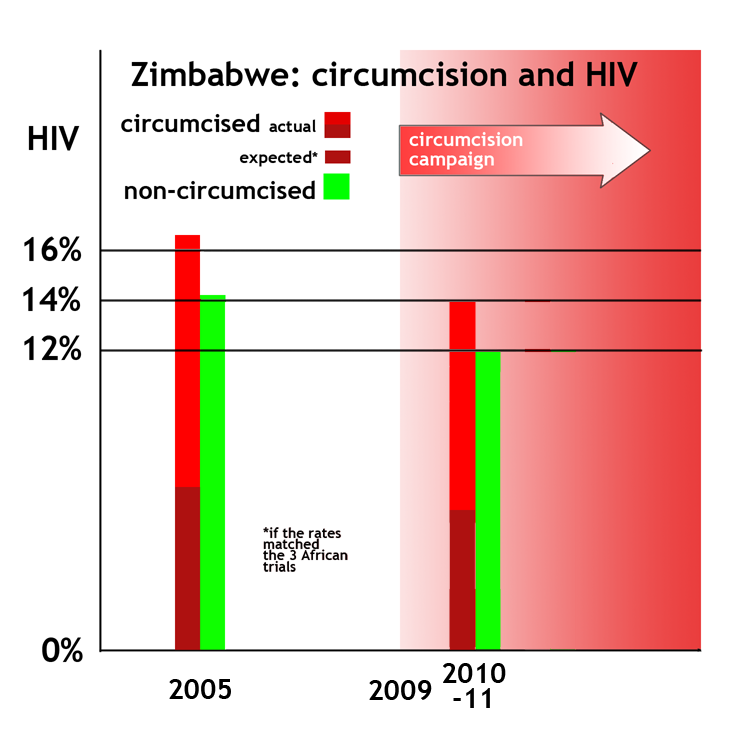
[There is no evidence that circumcising men in Zimbabwe has any effect against HIV.]

Zimbabwe - more circumcised men had HIV in 2005 and still do
Click to enlarge

This is the third year into the five-year target. The senior doctors also urged Government to expedite initiation of neo-natal circumcisions. [The men aren't buying it, so they come after the babies.]

"The problem is that male circumcision came as a programme where a few selected people were trained and put in charge. And yet this is a simple procedure which any medical doctor can perform," said the acting PMD for Matabeleland North, Dr Nyasha Masuka.

"Teams are coming from Harare or Bulawayo into our provinces, pitch their tents under a tree, circumcise a few men, and get paid hefty allowances and then leave."

Dr Masuka said the approach frustrated other doctors and patients.

"Some people hear of the programme when teams are long gone and the local doctor has to explain to them that the teams have left," he said.

...

Dr Zizhou said ... "If an old man from the village can perform this procedure [sometimes killing the patient] , then any doctor should be able to do that," ...

Acting PMD for Mashonaland West Dr Solomon Mukungunurwa said circumcision services should be universally accessible.

"If we are to realise full benefits of this programme, circumcision should start as soon as a child is born."

...

Tuesday, October 23, 2012

BOTSWANA: Overcrowded inmates being circumcised

The Monitor (Botswana)
October 22, 2012

133 prisoners circumcised


By Keobonye Majatsie
The Botswana Prisons Service (BPS) has adopted the Safe Male Circumcision (SMC) programme to reduce the spread of new HIV/AIDS infections.

Speaking at a press briefing, Dr Rachel Seleka revealed that so far 133 inmates have undergone circumcision at their clinics."So far we have at least 133 inmates from Gaborone, Moshupa and Molepolole prisons circumcised since April last year but we have not taken our initiative to the northern part of the country," she said.

Government introduced the SMC programme a few years ago, and there have been calls for the initiative to be extended to other vulnerable groups outside mainstream society. Seleka said they have discovered that inmates take health related issues more seriously when they are incarcerated.

Admitting that sodomy is a sensitive issue Prisons chief, Motlalekgosi acknowledged that there is sodomy in Botswana prisons. "We know that sodomy is illegal in Botswana but it happens in our prisons, how we don't know. If it can happen in mainstream society, what about in places like prisons? I don't have evidence to say it's not happening but we have heard stories narrated by ex-inmates," he said. ...
He also decried overcrowding in prisons. Currently there are 3,048 local male convicts and 435 foreign male inmates, 60 female citizen convicts and 14 female foreign convicts. There are 634 remanded local males, 303 foreign males, 15 local females and 11 foreign females. Motlalekgosi said these figures represent 15.2 percent overcrowding.

...

On other issues, Motlalekgosi revealed that they have banned smoking in all their prison facilities to curb drug smuggling in prisons. ...

[So let's see. They've circumcised men in overcrowded prisons where they know men are having sex together, and while no study suggests circumcision protects against male-to-male HIV transmission, one does suggest that sex too soon after the operation is a risk factor ... the men who can't smoke will get restless, and no mention of condoms ... What is wrong with this picture?]

Sunday, October 14, 2012

ILLINOIS: AAP bans Intact America booth from conference

October 12, 2012

Intact America banned from AAP Conference


By Hugh Young
Intact America has been banned from having a booth at the American Academy of Pediatrics Conference in New Orleans later this month.

The conference will be held at the Ernest N. Morial Convention Center and the Hilton New Orleans Riverside hotel from October 20 to 23, 2012

It includes a session on Tuesday October 23, called "Pros & Cons of Doing Circumcisions" that does not seem to say much about Cons but "aims to explain what one needs to do in order to set up a program to do neonatal circumcisions and how one can become an expert circumciser."

Demonstrators against the AAP's policy on circumcision are expected from all over the United States.

The AAP says...
Intactivists say...
AAP president with hands written Still from ''Wash your hands of the AAP'' video


Intact America's press release

Intact America
October 11, 2012

INTACT AMERICA, THE NATION'S LEADING CRITIC OF INFANT CIRCUMCISION,
KICKED OUT OF THE AMERICAN ACADEMY OF PEDIATRICS' NATIONAL CONVENTION

AAP cites website content, Facebook page for barring exhibition booth for which the group had already accepted payment. Intact America plans protests in streets of New Orleans when AAP meets starting October 20th.
TARRYTOWN, NY—The American Academy of Pediatrics, reeling under criticism by advocates for human rights and children’s health of its recent report seeking reimbursement for neonatal male circumcisions, today suddenly canceled a contract that the nation’s leading group criticizing the unnecessary surgery had signed for an exhibition booth at its upcoming convention in New Orleans.
“The AAP has stacked the deck by filling its Circumcision Task Force with pro-circumcision doctors and activists, and apparently is afraid to let its members learn the truth about the unnecessary, unethical, and risky surgery its members perform more than a million times a year on unconsenting baby boys,” said Georganne Chapin, Executive Director of Intact America, which has exhibited at several recent AAP conventions without incident.
“They can kick us out of their hall, but they can’t escape the growing realization that they have trapped themselves in an ethical quagmire by seeking reimbursement for surgery the American Medical Association properly calls ‘non-therapeutic,’” Chapin said. “They know that growing numbers of American parents are saying no to the removal of healthy functioning tissue from the genitals of their baby boys in a surgery that is a violation of medical ethics and the baby’s basic human rights.”
While the male circumcision rate in the United States was around 80 percent 30 years ago, it has steadily dropped to around 50 percent today. In Europe, circumcision rates in most countries are well under 10 percent, and European physician groups and even courts are now calling for doctors to stop performing all child circumcisions that are not medically indicated.
The AAP action came shortly after Chapin authored an essay appearing in the Huffington Post, arguing that the AAP was acting more like a trade association than a doctors’ organization that claims to be “dedicated to the health of all children.” In its report issued this summer, the AAP Task Force acknowledged that there were not enough benefits to justify recommending circumcision, but sought to win approval for reimbursement by insurance companies and the 18 states’ Medicaid programs where the surgery is currently not covered.
“Although health benefits are not great enough to recommend routine circumcision for all male newborns, the benefits of circumcision are sufficient to justify access to this procedure for families choosing it and to warrant third-party payment for circumcision of male newborns,” the report reads.
The AAP relied heavily on studies of sexually-active adult African men and the role circumcision might play in retarding female-to-male—but not male-to-female—transmission of the HIV virus linked to AIDS. The AAP and Centers for Disease Control correctly report there is no evidence circumcision plays any role in retarding male-to-male HIV transmission, which along with sharing intravenous needles is the predominant mode of HIV transmission in the United States.
“Ethical and scientific problems with the African research aside, trying to extrapolate from studies of sexually active adult African men to infant boys in America is bad science, bad medicine and bad health policy,” Chapin said. “Medical ethics requires necessity and informed consent for something as invasive as surgery. The foreskin is normal tissue, an integral part of the male anatomy that protects the rest of the penis and plays an important role in sexual pleasure. Babies should be left alone; when they become men, they can make their own informed decision about whether they want to remove a part of their own penises.”
“Not only does the AAP Task Force report ignore the ethical obligation of physicians to respect their patients' autonomy and do no harm, it repeatedly calls for doctors to be paid for removing healthy, functioning tissue from somebody who cannot consent,” Chapin wrote.
The AAP letter, sent from its Illinois headquarters and dated October 10th, cited content on Intact America's website and Intact America’s Facebook page in withdrawing the organization’s approval for the exhibit booth. The letter notes that the AAP respects Intact America’s right to protest outside the convention center, which was something already planned for the weekend of the convention.
“Pediatricians must be reminded that their patients are the babies,” Chapin said. “If we can’t remind them in the hall, we will remind them in the streets of New Orleans.”

Intact America operates under the auspices of the Hudson Center for Health Equity & Quality, a not-for-profit organization that is tax-exempt under section 501(c)(3) of the internal revenue code.